
The workshop explores the fruitful encounter between cultural heritage, traditional construction techniques and modern digital morphogenetic tools. Through the study and parameterization of arts such as basketry, marble work, shipbuilding, loom weaving, pottery, carpentry and joinery techniques, students will develop design systems using Grasshopper3D.
The main goal of the course is to transcribe aspects of cultural heritage and artisanal logics into algorithmic rules, and apply them to modern architectural prototypes, with an emphasis on digital fabrication (CNC, 3D printing, robotic assembly, modular construction, laser cutting, joinery, etc.).
Students are invited to develop a hybrid system (digital + analog) that will translate craft knowledge into a spatial or morphological proposition.
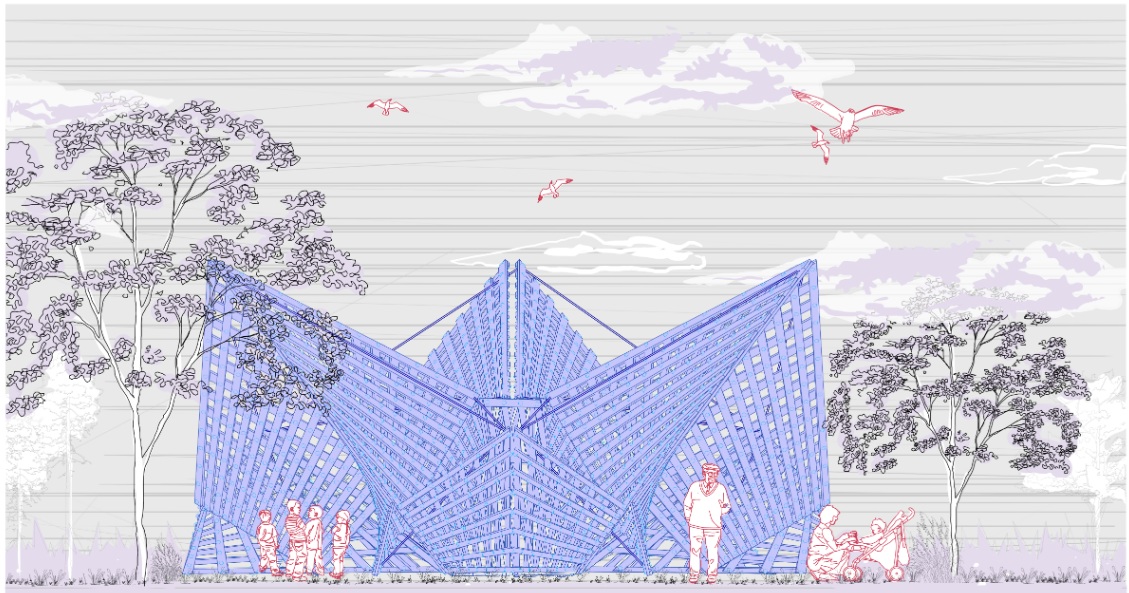
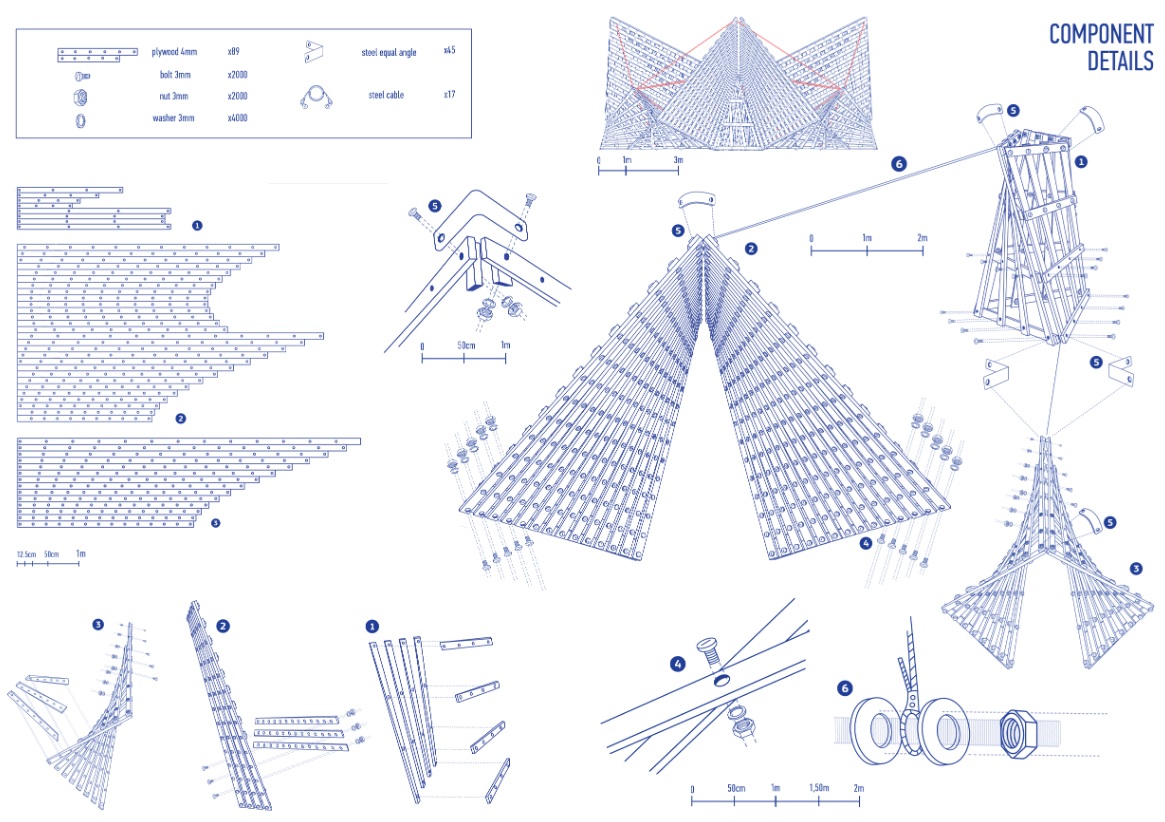
Short video: https://www.youtube.com/watch?v=tIn3JSD0a9w
From the project of students Karliotis, Lyviaki, Tsilomitrou
The design studio will utilize design inquiry methodologies and utilize a wide range of design media, analog and digital tools. These will include physical modeling, form finding, and a variety of material systems, along with morphogenetic algorithms, simulations, visualization, and immersive 3D experiences.
Specifically, students are expected to be proficient in 3D software, Rhino, and 3Dmax, and be willing to learn about algorithmic design in Grasshopper, coding, AI tools, and immersive VR/AR
A series of guest speakers to be announced throughout the semester will complement the course, providing insights and tools for digital-analog collaborations in design.
- To understand and design geometrically complex forms
- To extract design practices and rules from traditional arts (Basketwork, Marblework, Shipbuilding, Weaving, Pottery, Woodworking, Instrument Making, Joinery Techniques)
- To be able to parameterize design and construction rules, which will be extracted from craft practices
- To design a basic structural system based on algorithmic rules and digital tools
- To be able to produce in an automated way the construction drawings for the construction of the individual elements, using digital technology
- To be able to organize the sequence of tasks from design to construction
- To resolve construction details of unconventional architecture and apply them to models
The studio explores how traditional craft techniques can become carriers of morphological principles, capable of being reinterpreted through parametric design and digital fabrication. Instead of reproducing patterns, we approach the technique as an algorithm – as a logic of action that encodes relationships, topologies, behaviors.
Research - Design inquiries:
- Morphogenetic Crafting: From weaving, basketry, wooden shipbuilding and other traditional crafts to morphogenic processes for architectural design
- Digital Heritage: How we will preserve and manage cultural, historical and artistic features through digital technologies.
- Imperfect geometry and noise: Design with tolerances, deviations, random or intentional errors
- Analog-digital interaction: Experimentation with Grasshopper, Rhino + physical models, improvised tools, low-tech techniques
- Materiality as information: Material as an "intelligent" carrier of form and behavior (material agency)
- Human body and gesture: Manual actions as spatial protocols, embodied knowledge integration, parameterization of the gesture of space production.
The studio focuses on the potential of digital design and fabrication tools for the creation of architectures, which aim to expand the possibilities of design and fabrication in new experimental and innovative directions. The topics that will be addressed by the students are:
- Design in combination with construction, since the two processes are interrelated and one feeds the other, creating a design-build continuum
- Investigation of design, manufacturing, assembly, interconnection, optimisation and assembly systems
- Familiarisation with algorithmic design and computational thinking tools in architecture
- Modern design methodologies, morphogenetic processes and representations
- Interdisciplinary approach and integration of knowledge and design strategies
Good knowledge of 2D/3D computer-aided design, knowledge of the machinery of the prototyping lab is required. Knowledge of algorithmic design (grasshopper3d or code) is desirable. Knowledge contained in the course is used to a significant extent within the course: Computer Aided Design I & II. Therefore students who have taken any or all of these will have a comparative advantage and greater fluency in implementation.
Students will work in small groups. The evaluation will be based on exercises during the semester (research, digital experiments, models) and the final deliverable that will be a fully articulated and documented design proposal for a small-scale architectural construction with all the construction details (floor plans, views, sections , three-dimensional illustrations, animations, digital designs) and mock-ups of the construction and the individual components, nodes and links on a larger scale.
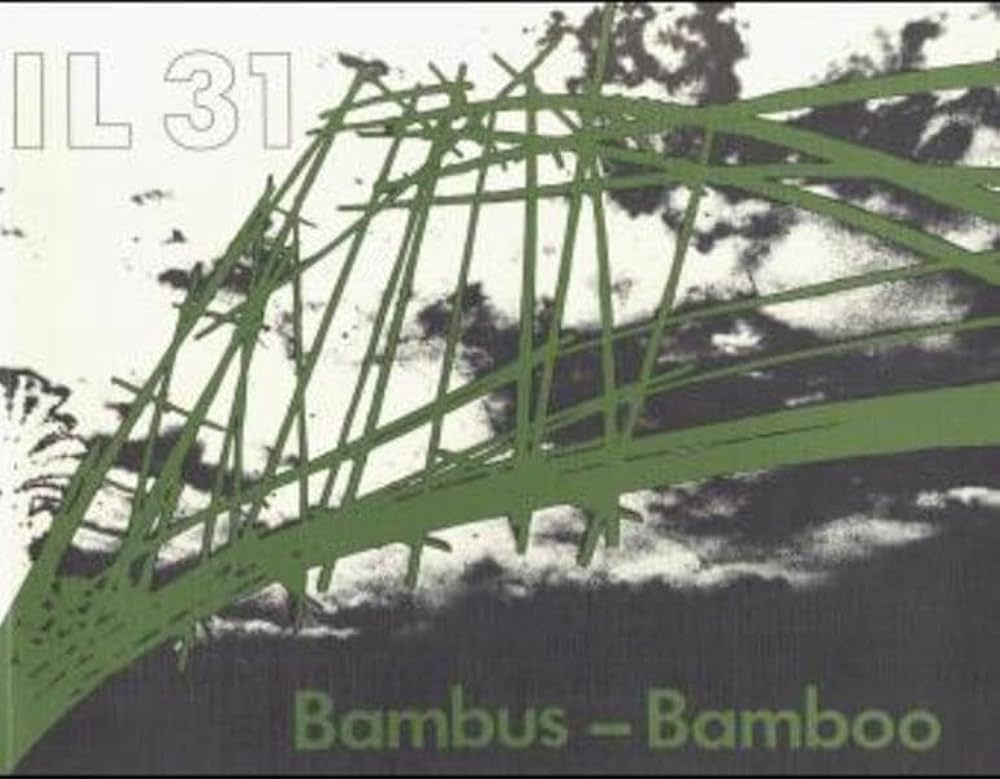
https://digibus.ub.uni-stuttgart.de/viewer/image/1693555504835_IL31/
All IL Periodicals found here: https://www.ilek-collections.de/il-periodicals
Adriaenssen, S. (ed), Advances in Architectural Geometry 2016, Hochschulverlag AG, ETH Zurich, 2016. File source και Download link
Baker L. Temporary Architecture. Salenstein: Braun Publish,Csi, 2014.
Gramazio F, Kohler M. Digital Materiality in Architecture. 1 edition. Baden: Lars Muller, 2008.
Hensel, M., Menges, A. (eds). Morpho-Ecologies: Towards Heterogeneous Space In Architecture Design, AA Publications, 2007.
Hensel, M., Menges, A. (eds). Versatility and Vicissitude: Performance in Morpho-Ecological Design,Academy Press, 2008.
Iwamoto L. Digital Fabrications: Architectural and Material Techniques. 144 p. edition. New York: Princeton Architectural Press, 2009.
Kolarevic, B. (ed.), Architecture in the Digital Age: Design and Manufacturing. 1 edition. Taylor & Francis, 2004.
Leach, N., Williams, C., Turnbull, D. (eds) Digital Tectonics, Academy Editions Ltd, 2004.
Legendre, G. (ed), Mathematics of Space, Academy Press; 1 edition, 2011. File source
Long, K. (ed.), Hatch: The New Architectural Generation, Laurence King Publishing, 2008.
Pavlea, E. Algorithmic handcrafts: poetic narratives in the work of Pantelis Xagoraris, Doctoral Thesis, Aristotle University of Thessaloniki, 2025.
Picon, A., Digital Culture in Architecture, Birkhäuser Architecture; 2010.
Sakamoto, T. (ed), FROM CONTROL TO DESIGN, Actar, 2008.
Self M, Walker C. Making Pavilions. London: Architectural Association Publications, 2010.
Spuybroek, L. (ed), Research & Design: The Architecture of Variation, Thames & Hudson, 2009.
Interesting links:
https://dbt.arch.ethz.ch/project/digital-bamboo/
https://papers.cumincad.org/data/works/att/acadia22_406.pdf
https://ar.itb.ac.id/wp-content/uploads/sites/162/2017/07/Stamm-Bamboo-Nature-and-Business-web.pdf
https://wewanttolearn.wordpress.com/category/resources/inspiration/frei-otto/
https://humanitarianlibrary.org/sites/default/files/2014/02/INBAR_technical_report_no20.pdf