
Elective at semester(s) 6, 8, ECTS: 3
Generic Competences: Ability to work autonomously, Ability to work in an interdisciplinary environment, Capacity to generate new ideas (creativity), Ability to interact constructively with others regardless of background and culture and respecting diversity, Commitment to conservation of the environment, Ability to demonstrate social, professional and ethical responsibility and sensitivity to gender issues, Ability to be critical and self-critical.
The course adopts the theoretical and political framework of “decolonization” and seeks to explore its significance in architectural education, research, and practice. Its main premise is that coloniality—the enduring structures of power inherited from colonialism that continue to shape the production of knowledge to this day—finds multiple expressions within the epistemological field of architecture. Moreover, these structures are reproduced through architecture itself, as a practice of spatial formation and the production of the built environment.
Aiming to address the challenges of the “decolonization of architecture” in the present context, with particular emphasis on the Greek framework, the course introduces students to critical theoretical tools with a dual purpose. First, it seeks to understand the ways in which architectural forms of knowledge, dominant discourses, and representations (of history, the human, the body, the environment, sustainable development, etc.) have been historically intertwined with patriarchy, neo/colonialism, and racial capitalism. Second, it aims to highlight how architectural practice is connected to dominant design and construction cultures and the material transformations of landscapes—reinforcing social, gendered, and racial divisions, as well as multiple forms of violence against human communities and ecosystems.
Through weekly thematic lectures, guest talks, and theoretical assignments, the course familiarizes students with a wide range of theoretical approaches and conceptual tools, drawing on the work of key thinkers such as Michel Foucault, Edward Said, Gayatri Chakravorty Spivak, bell hooks, Henri Lefebvre, Michel de Certeau, James Holston, Achille Mbembe, Ann Stoler, Anna Tsing, Rob Nixon, Arturo Escobar, and others. By exploring the significance of these critical perspectives in understanding and questioning dominant assumptions in architectural theory and practice, the course approaches the question of the “decolonization of architecture” not merely as a matter of critique and contestation, but as a fertile field of engagement with issues of social and environmental justice—and of envisioning (and designing) a just and livable planetary future.
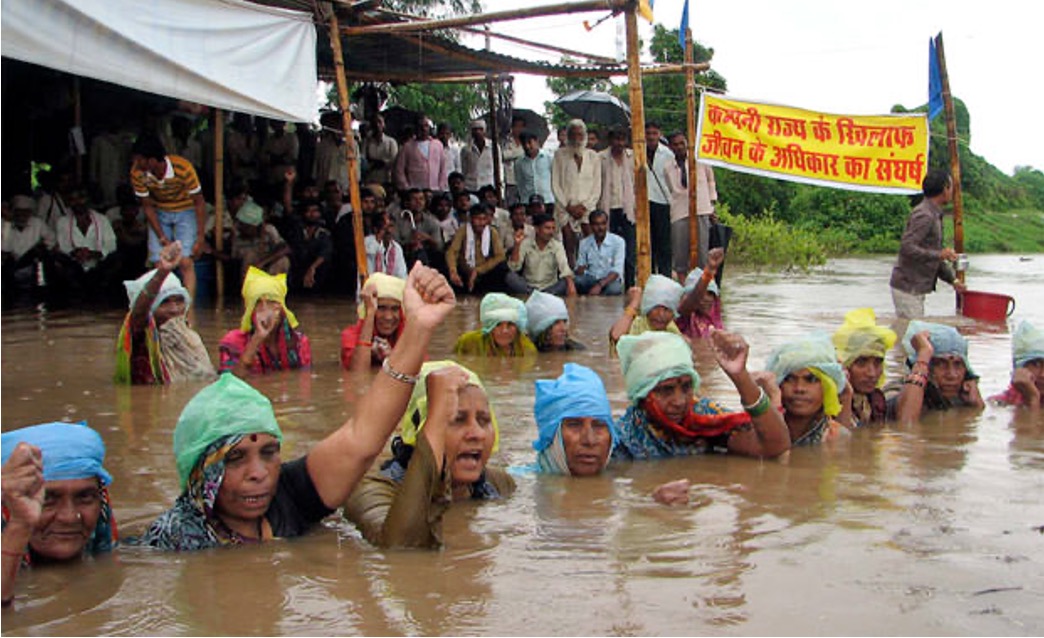
Mobilizations of Indigenous women in India against dam construction, Narmada Valley Development Project, 1980–present.
Knowledge, Comprehension, Application, Evaluation