
Design Studio Required Elective at semester(s) 6, 8, ECTS: 12
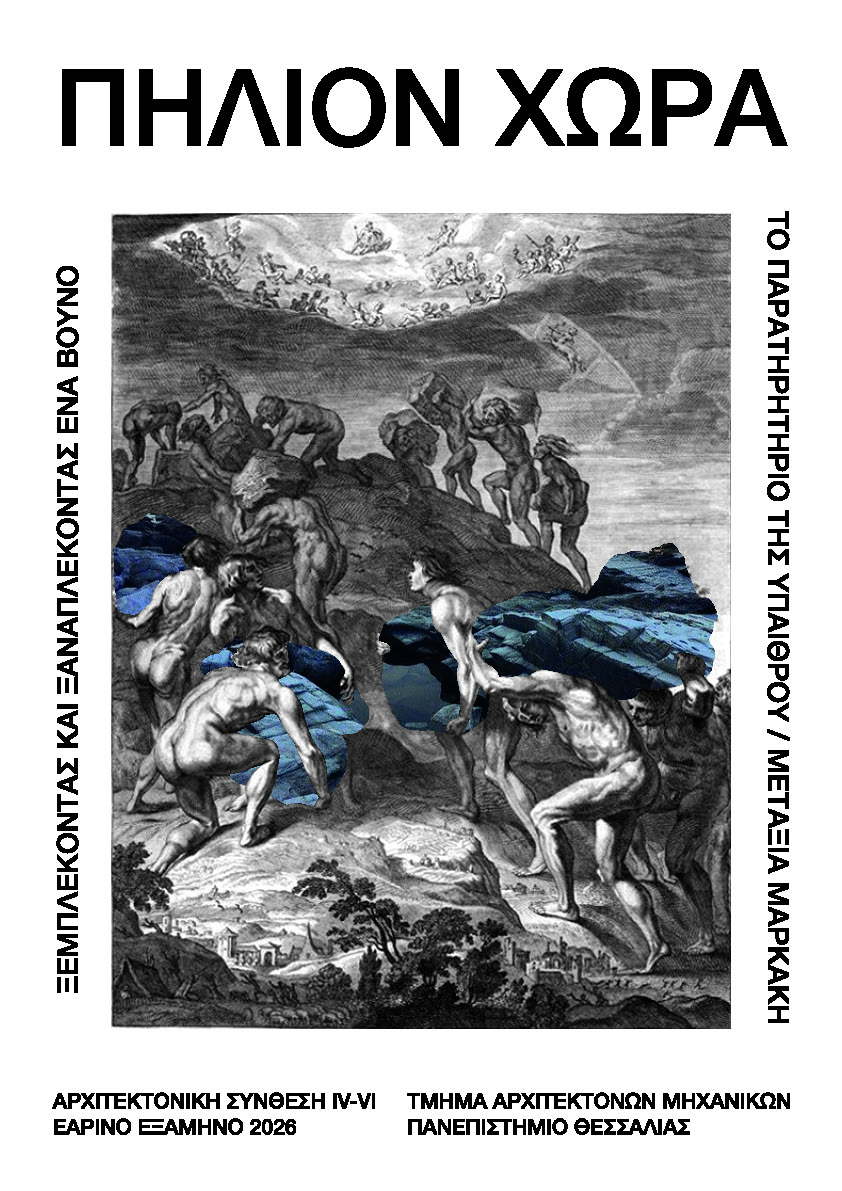
According to myth, the Giants Otus and Ephialtes stacked mountains in order to reach the gods on Olympus, creating Mount Pelion as a natural “staircase” to the sky. In another account, Pelion was the summer dwelling of the gods — a place of transition and coexistence between different worlds. Between these two myths — of ascent, claim, and hybrid dwelling — the course poses its central question: what is the present and future of mountainous peripheral territories?
How do mountains, islands, and villages experience processes of urban transformation? How are they affected by the climate and economic crisis? And how can we, as architects and urbanists, respond to these challenges?
The Greek countryside often remains in the shadow of research and architectural inquiry, overshadowed by narratives produced in metropolitan centers. These are places that have been demographically weakened and frequently abandoned by state care, yet at the same time they constitute sites of intense claims, ecological transformations, and social struggles. Landscapes deeply affected by the climate and economic crisis, while being called upon to assume crucial roles in social and ecological sustainability. The most significant struggles over land, water, energy, and the commons unfold today outside the city, in territories that nonetheless remain marginal within architectural thought. It is there that situated practices and forms of coexistence persist, narrating stories of socio-ecological resistance, even as they remain under continuous pressure.
The course begins from the need for an eccentric positioning: a shift of architectural thinking beyond the narrow limits of the city and a claim for an active role in the knowledge and design of the countryside as a social and ecological common. The question of scale and complexity becomes central: how can we design within a field where geological durations, human trajectories, ecological systems, and imaginary narratives coexist?
The term “Pelion Chōra” allows us to imagine, beyond the idea of a compact mountain, a dynamic place where different temporalities, ecologies, and forms of life coexist, overlap, and transform one another.
Through cartography, fieldwork, and qualitative ethnographic analysis, we disentangle the mountain into layers — geological, social, ecological, and imaginary — and recompose it as an evolving condition of life. A place that is not exhausted by its form, but emerges through the relationships that traverse it — investigating the architecture of a different “chōric" (spatial) condition, one that actively engages with processes of life and dwelling.
The course proposes a substantive shift in architectural thinking: from the object to the field, from form to relation, from the center to the periphery. It offers theoretical, methodological, and design tools that enable a critical approach to the production of space within the contemporary ecological and political condition. At the same time, it establishes a pedagogical process that synthesizes theoretical, research-based, and design-oriented approaches, cultivating — through experiential processes — students’ ability to research through design and to design through research, developing an architectural practice that connects spatial thinking with its social and ecological contexts.
Assessment is based on attendance and active participation in the course, the submission of intermediate assignments and participation in interim presentations, as well as the quality of the final project, with particular emphasis placed on analytical ability and critical synthesis.