

Lecture by Stavros Stavrides “Inhabiting Spaces of the Commons: Collective Housing as a Space of Sharing”
Tuesday 12/5/2026 18:00-20:00 – Foyer
Download the poster.
The lecture will take place in person as part of the series of events “Co-habiting Vacancies: From Vision to Claims”co-organized by the Department of Architecture of the University of Thessaly (Dept.Arch UTh) and the open research-action collective CoHab Athens, between 11/5/2026-22/5/2026.
Speaker bio:
Stavros Stavrides, architect and activist, is Emeritus Professor of architectural design and theory at the School of Architecture, National Technical University of Athens, Greece, where he presently teaches a postgraduate course on the meaning of metropolitan experience and research methodologiesand supervises phd theses. He is member of the NTUA Lab for the Architectural Design and Communicationas well as founding member of the independent Laboratory for the Urban Commons. He has done extensive research fieldwork in Brazil, Uruguay, Argentina, Colombia, Venezuela and Mexico focused on housing-as-commons and on urban struggles for self-management.His recent publications include The Politics of Urban Potentiality (London 2024), Housing as Commons (co-edited with Penny Travlou, London 2023), Common Spaces of Urban Emancipation (Manchester 2019), Common Space. The City as Commons, (London 2016, Istanbul 2016, Athens 2019, Lisbon 2021, Milano 2022, Bucharest 2024, Seoul 2022), Towards the City of Thresholds (Trento, 2010, Madrid 2016, Istanbul 2016, N. York 2019), Suspended Spaces of Alterity (Athens, 2010) and From the City-as-Screen to the City-as-Stage (Athens, 2002 National Book Award) as well as numerous articles on spatial theory and the urbancommoning culture. He has lectured in European and North and SouthAmerican Universities on urban struggles and practices of urban commoning.
Personal homepage: https://stavrosstavrides.com/

The Department of Architecture of the University of Thessaly (Dept.Arch UTh) and the open research-action collective CoHab Athens are organizing an exhibition and a parallel events titled: “Co-habiting Vacancies: From Vision to Claims”, taking place from May 12 to May 21, 2026.
The exhibition presents the outcomes of the collaborative youth competition “CoHabiting Vacancies” (2024–2025), organized by CoHab. The competition aimed to explore possibilities for the reuse and transformation of vacant buildings—primarily owned by public institutions or non-profit organizations—into various forms of cooperative housing, tailored to local needs. The innovative competition proposals demonstrate that the cooperative housing model can serve as a meaningful tool for securing more affordable and higher-quality housing. At the same time, it promises to offer a sustainable response both to the housing crisis and social isolation, as well as to the underutilization of vacant buildings in Greek cities and the countryside.
The exhibition was first presented in Athens (November 2025) and, following Volos, will travel to Thessaloniki, serving as a platform for exploring alternative housing models and collective living practices across different local contexts. Drawing on the visionary ideas proposed by young students and professionals for transforming vacant buildings into spaces of shared living, solidarity, and care, and informed by international examples, the Department of Architecture of the University of Thessaly and CoHab Athens aim to foster a broader dialogue with local stakeholders and communities. This dialogue focuses on the institutional, social, and architectural challenges involved in promoting cooperative and collective housing.
As part of the program, the following public events will take place:
A) Competition exhibition“Co-habiting Vacancies: From Vision to Claim”. Opening: Tuesday, May 12, 20:30. Exhibition hours: Daily 10:00–20:00 until Wednesday, May 21, at the Exhibition Space, Department of Architecture, UTh.
B) Scientific symposium & open discussion “Inhabiting the Commons. Collective Housing as a Space of Sharing” with keynote speaker Stavros Stavrides, Emeritus Professor, School of Architecture, National Technical University of Athens. It will take place on Tuesday, May 12, 18:00 at the Department of Architecture, UTh.
C) “Participatory Workshop for Inclusive Co-Housing” open toUTh students and other individuals interested in cooperative models and collective housing. It will take place on Wednesday, May 13, 15:00–17:00 at the Central Library of the University of Thessaly. [Register for the participatory workshop:https://forms.gle/MMJKLmR7TtPY6sqr9]
D) Open discussion “Alliance for Cooperative Housing” with the participation of organizations based in the Thessaly region. Short presentations and an open discussion will highlight the prospects of cooperative housing models and collective initiatives at local and regional levels. It will take place on Wednesday, May 13, 18:00–20:00, at the Central Library of the University of Thessaly
The events are part of the ongoing, close collaboration between the Department of Architecture of the University of Thessaly and the open research-action group CoHab Athens. Their shared aim is to inform and activate public dialogue around critical social and spatial challenges, while actively contributing—through academic knowledge and collaborative networks—to addressing them.
Lecture by Sotiris Tsoukarelis entitled Decentralization, Commons, and the Social & Solidarity Economy: A Cosmoregional Model of Development for Mountain Regions
Thursday 7/5, 10.00, Loft
Sotiris Tsoukarelis is a founding member and Head of Social Innovation at the Social Cooperative Enterprise Ta Psila Vouna (“The High Mountains”).He studied Political Science at the University of Crete, specializing in political philosophy and local development. He also attended the Metsovion Interdisciplinary Research Center of the National Technical University of Athens, focusing on Environment and Development in Mountain Regions. Since then, he has considered himself an activist for mountain areas, decentralization, and the agri-food sector. He actively participates in environmental movements defending his local region and promotes alternative models of production and living based on cooperation, the development of local communities, and their connection to global networks.He is also an active farmer, cultivating vegetables at an altitude of 1,000 meters on his model farm in Demati, Zagori. In addition, he has trained at the American Farm School in the fields of Tourism Experience Design, Marketing, Alternative Tourism, and Agritourism. He is also a dairy farmer and cheesemaker, and a graduate of the Dairy School of Ioannina.Sotiris serves as President of the Epirus Union of Social and Solidarity Economy Organizations, “Koino K.A.L.O.,” and as Vice President for Ecosystem Development of the Panhellenic Confederation of Social and Solidarity Economy Associations, “PA.SE KAL.O.” Since January 2024, he has been an advisor to the Mayor of Ioannina on matters related to the social economy and serves as CEO of the Municipal Real Estate Development Company of Ioannina (DIANETAI).
Lecture by Athina Vitopoulou “Post-Anthropocentric Design και Multispecies Coexistence in the Era of Climate Change”
Wednesday 6/5/2026 19:00-21:00 - Room Γ and online (MS Teams)
Download the poster.
The lecture will take place in-person and online as part of the course: COHABITING IN THE GARDEN: ARCHITECTURES OF CARE
Instructor: P. Phokaides, Assistant Professor, UTh
Short bio:
Athina Vitopoulouis an Architect Eng. (AUTH). She holds a DEA in Projet architectural et urbain : théories et dispositifs (Ecoles d'Architecture καιInstitut Français d'Urbanisme-Université Paris 8), and a PhD in History and Civilisations (EHESS, Paris, «Grand Prix de Thèse sur la Ville 2011»).She is Associate Professor at the School of Architecture, AUTH. Since graduation, she has been active in the fields of Urban Design and Planning and has participated as a team member in urban design and planning projects and architectural competitions. Shehas developedreachresearch, teaching and writing activity on issues related to the theory and practice of sustainable urban design and planning, environmental design, urban policiesand their socio-spatial impacts, land policies, mechanisms and processes of urban space production, participatorydesign practices, urban history and town planning history, institutional framework of spatial planning, protection and enhancement of urban cultural heritage.
Lecture + Documentary Screening
Movement, Production, and Memory:From Anchialos in Eastern Rumelia to Nea Anchialos in Magnesia through the Archives of the “DIMITRA” Cooperative
Alexandros Kapaniaris
Thursday 30.4, 14:00
This presentation examines the dynamic relationship between population movements, productive activity, and the formation of collective memory, focusing on the transition from Anchialos in Eastern Rumelia to Nea Anchialos in Magnesia. Through the archival records of the “DIMITRA” Cooperative, the study highlights the ways in which refugees reconstructed their economic and social lives, transferring knowledge, practices, and identities to their new place of settlement.At the same time, the presentation explores how production — particularly within the agricultural and cooperative sectors — functioned not only as a means of survival but also as a vehicle for preserving and reshaping memory and cultural continuity. In this way, productive activity contributed to the formation of a new local identity deeply rooted in the past.
Bio
Alexandros G. Kapaniaris holds a PhD in Digital Folklore from the Department of Preschool Education and Educational Design at the University of the Aegean. He has completed two postdoctoral research projects on archival ethnography at the Department of History & Ethnology of Democritus University of Thrace. He has taught courses on digital cultural heritage, digital applications and new technologies, and cultural management at the Universities of Piraeus, Ioannina, Western Macedonia, Democritus University of Thrace, and the Hellenic Open University.
During 2021–22, he was a Visiting Research Fellow at the Department of Political Science and International Relations of the University of the Peloponnese, conducting research on archival ethnography related to migration.Since 2017, he has served as a Tutor-Counselor at the Hellenic Open University and, for the past two years, in the postgraduate program Digital Humanities, where he also coordinates the thematic unit “Digital Management of Cultural Heritage (ΨΑΕ60).”
From 2014 to 2021, he was the scientific coordinator of the project marking the 100 years of continuous operation of the Zagora Agricultural Cooperative, documenting the organization’s memory and history under the title “A Century of Cooperative Tradition and Struggle.” From 2018 to 2023, he was also the scientific coordinator of the centennial project for the Nea Anchialos Agricultural Winemaking Cooperative “DIMITRA,” documenting the organization’s memory and history under the title “From Anchialos of Eastern Rumelia to Nea Anchialos of Magnesia: Memories of Refuge and Histories of Cooperation.”
In 2014, for his work “The Mayides of Makrinitsa,” in 2018 for “Digital Folklore and Education,” and in 2019 for the two-volume work “Zagora Agricultural Cooperative: A Century of Cooperative Tradition and Struggle – History, Cooperative Values, and the Culture of Agricultural Production,” he was awarded the “Lysimachos Kaftantzoglou Prize” by the School of Philosophy of the National and Kapodistrian University of Athens.
Within the framework of the course MACHINE IN THE GARDEN: Wanderings Through the Countryside
By The Observatory of the Countryside
Tutor: Metaxia Markaki
For the link contact memarkaki@uth.gr
Lecture + Documentary Screening
Untangling the Culture of Agricultural Production in Pelion: The Historical Archive of the Zagora Agricultural Cooperative (1916–2016) as a Field for Documenting and Reconstructing Mountain Space
Alexandros Kapaniaris
Thursday 30.4, 11:00
This presentation explores the culture of agricultural production in Pelion through a multilayered reading of the historical archive of the Zagora Agricultural Cooperative (1916–2016), approaching it as a dynamic field for documenting and reconstructing mountain space. Through administrative documents, accounting ledgers, correspondence, and materials of everyday practice, the research highlights transformations in productive relations, forms of collective organization, and strategies for managing natural resources within a demanding geographical environment. At the same time, the analysis sheds light on the ways cooperative structures contributed to the formation of local identities and the integration of tradition into contemporary practices, offering an interpretive framework for understanding both continuity and rupture in mountainous rural landscapes.
Bio
Alexandros G. Kapaniaris holds a PhD in Digital Folklore from the Department of Preschool Education and Educational Design at the University of the Aegean. He has completed two postdoctoral research projects on archival ethnography at the Department of History & Ethnology of Democritus University of Thrace. He has taught courses on digital cultural heritage, digital applications and new technologies, and cultural management at the Universities of Piraeus, Ioannina, Western Macedonia, Democritus University of Thrace, and the Hellenic Open University.
During 2021–22, he was a Visiting Research Fellow at the Department of Political Science and International Relations of the University of the Peloponnese, conducting research on archival ethnography related to migration.Since 2017, he has served as a Tutor-Counselor at the Hellenic Open University and, for the past two years, in the postgraduate program Digital Humanities, where he also coordinates the thematic unit “Digital Management of Cultural Heritage (ΨΑΕ60).
”From 2014 to 2021, he was the scientific coordinator of the project marking the 100 years of continuous operation of the Zagora Agricultural Cooperative, documenting the organization’s memory and history under the title “A Century of Cooperative Tradition and Struggle.” From 2018 to 2023, he was also the scientific coordinator of the centennial project for the Nea Anchialos Agricultural Winemaking Cooperative “DIMITRA,” documenting the organization’s memory and history under the title “From Anchialos of Eastern Rumelia to Nea Anchialos of Magnesia: Memories of Refuge and Histories of Cooperation.”
In 2014, for his work “The Mayides of Makrinitsa,” in 2018 for “Digital Folklore and Education,” and in 2019 for the two-volume work “Zagora Agricultural Cooperative: A Century of Cooperative Tradition and Struggle – History, Cooperative Values, and the Culture of Agricultural Production,” he was awarded the “Lysimachos Kaftantzoglou Prize” by the School of Philosophy of the National and Kapodistrian University of Athens.
Within the framework of the course PELION CHŌRA: Dissecting and Reweaving a Mountain
By The Observatory of the Countryside
Tutor: Metaxia Markaki
For online attendance contact memarkaki@uth.gr
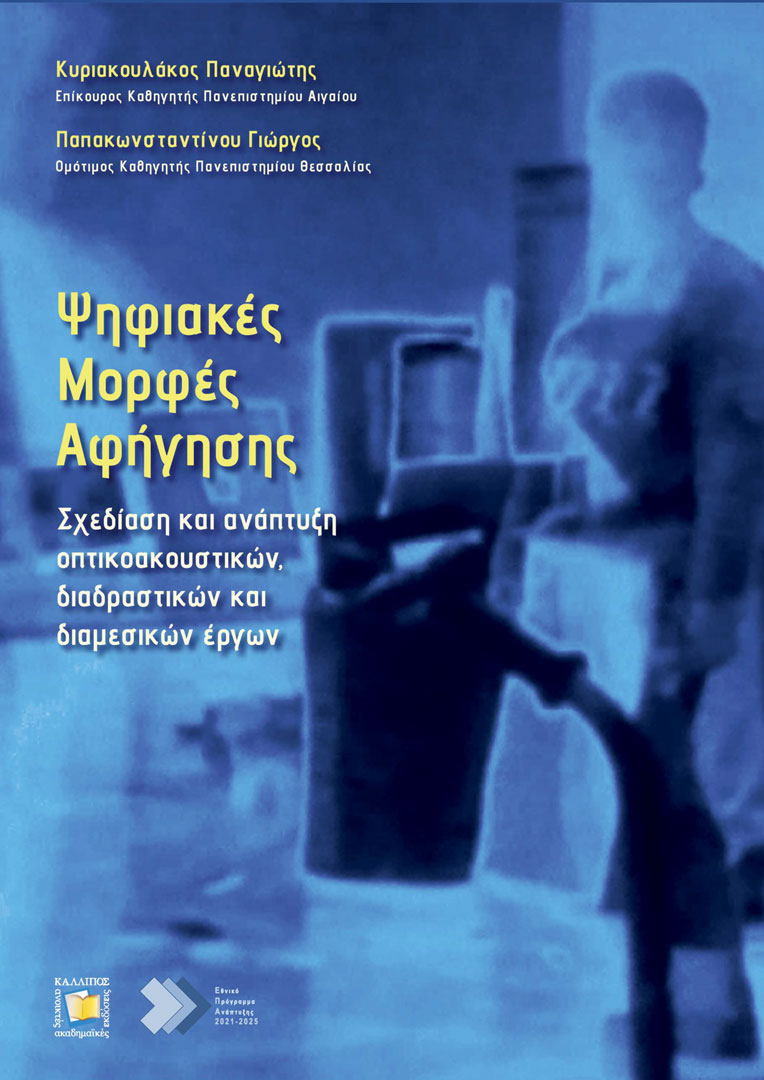
The publication “Digital Narrative Forms - Design and development of audiovisual, interactive and transmedia projects” by the authors George Papakonstantinou (Professor Emeritus, Department of Architecture, University of Thessaly) and Panagiotis Kyriakoulakou (Assistant Professor, Department of Product Design Engineering and Systems, University of the Aegean) was posted on Kallipos, an open academic e-books platform.
The work is dedicated to our dear friend and colleague Spyros Papadopoulos, Director of LECAD and President of Dept. ARCH, who passed away so early. His work continues to inspire and motivate us.
https://repository.kallipos.gr/handle/11419/15090?&locale=en
The Soup of the Mountain and the City - Edible places and other “urban-rural” encounters
Patari Metaptychiakou
Wednesday 22/4, 18:00
On Wednesday 22/4,we meet Nafsika Papacharalambous, a food anthropologist and chef, and we transform TAM into a large kitchen, where places and ingredients meet, mix, and recombine. The “soup” functions as a shared liquid field in which different elements, cultivation practices, and food relations are explored, coexist, and are transformed into a new edible condition and collective action.
INGREDIENTS:
The PELION CHORA team brings ingredients from the mountain.
What does an “edible mountain” mean, and how much of what we find in the markets of Volos—and the city more broadly—is produced in Pelion? We search for fruits and vegetables, cooperative products, or other materials connected to our study areas: herbs from the mountain; products from olive landscapes (oil, olives); fruits (e.g. apples) and vegetables from cultivated land; cooperative products (e.g. ZAGORIN); small-scale artisanal goods sold in Pelion’s tourist markets (e.g. Makrinitsa: kritharaki, hilopites, etc.). How far does the mountain reach? We bring mountain products and map the places they come from.
The COHABITING IN THE GARDEN team brings ingredients from the city.
What can one find at a street market, a small grocery shop, or a greengrocer? Are these locally produced in Thessaly, or do they connect to more distant geographies? Are they products of intensive agriculture and trade, or small-scale domestic production? We also look for “imperfect” vegetables or fruits—leftovers that might otherwise be discarded. Where do these products come from, how are they produced, and where do they end up if they are not bought?
The GEOGRAPHIES OF FOOD team brings ingredients from the region of Magnesia.
How is food mapped within a specific geography? What networks of production, distribution, and consumption shape it? We look for products originating from different areas of Magnesia (mountain, plain, city) and reflect on their journeys—from place of production to the plate. What do these routes reveal about the relationships between the local and the supra-local?
The collective cooking will be accompanied by a talk by Nafsika Papacharalambous titled “The Smell of the Countryside: Co-dwelling and Identity in Times of Crisis”, and a screening of the documentary The Grocer (2013) by Dimitris Koutsiabasakos.
You are all warmly invited to cook, eat, and discuss with us edible places, unexpected “urban-rural” encounters, and fluid, hybrid geographies around a large table and a bowl of soup!
“The Soup of the Mountain and the City” is prepared and consumed collectively as part of the Spring Semester 2026 courses:
PELION CHORA. Dissecting and Reweaving a Mountain
Instructor: Metaxia Markaki
Cohabiting in the Garden: Architectures of Care
Instructor: Petros Fokaidis
GEOGRAPHIES OF FOOD
Instructor: Thaleia Marou
Lecture by Nafsika Papacharalampous “The Smellof the Greek Rural: Commensality and Identity at Times of Crisis”
Wednesday 22/4/2026 18:30-19:00 – Patari Metaptychiakou
Download the poster.
The lecture will take place as part of the collective workshop titled: “The Soup of the City and the Mountain: Edible Places and Other ‘Urban-Rural’ Encounters”
Short bio:
Nafsika Papacharalampous is a social anthropologist and Research Associate at the SOAS Food Studies Centre, University of London. For more than a decade, she has been researching changing food systems during times of environmental and economic crises. Her work focuses on cuisine, identity, memory, the senses and the past as ways of understanding social change. Her current research extends this work to food waste, social justice and sustainability in Greece. She is the author of “The Metamorphosis of Greek Cuisine: An ethnography of deli foods, restaurant smells & foodways of crisis” (Routledge, 2023).Nafsika is also a chef and consultant, working with artisan food companies, restaurants and food organisations. She also curates culinary experiences around Greek food. She holds a PhD in Anthropology from the School of Oriental and African Studies, University of London, an MA in the Anthropology of Food from SOAS, and an MBA from the Athens University of Economics and Business. Website: www.nafsikacooks.com / @nafsikacooks
The lecture and the workshop are jointly organized as part of the following spring semester courses:
PELION CHŌRA: Dissecting and Reweaving a Mountain
Instructor: Metaxia Markaki
Cohabiting in the Garden: Architectures of Care
Instructor: Petros Phokaides
FOOD GEOGRAPHIES
Instructor: Thalia Marou
Blended Intensive Program (BIP)
Architecture(s) of Care 3: Occupy, Poetically
International Summer School – Pietra de’ Giorgi, Italy
15th - 19th of June 2026
Join us for a one-week residency in the hilltop village of Pietra de’ Giorgi, in the rural landscape of the Oltrepò Pavese, Northern Italy. Architecture(s) of Care 3: Occupy, Poetically invites students and early researchers to explore architecture as a collective, situated and experimental practice. Rather than learning about a place, participants will learn by inhabiting it. For one week, we will live and work together in the village, engaging with its spaces, rhythms and community while contributing to an ongoing project of cultural reactivation centred on the reopening of the village’s historic cinema as a social theatre. The programme combines critical mapping exercises, spatial observation and conversations with local actors with a hands-on construction workshop, where participants will collaboratively design and build small architectural elements for the public spaces around the cinema. Walking, mapping, building and sharing everyday life become part of a collective ritual of learning and making, where design is understood not as a finished object but as a process of care, negotiation and radical imagination. Participants will stay together in the village in a temporary residency setting, with accommodation and daily lunch provided throughout the programme. If you are interested in experimental pedagogies, rural futures and architecture as a form of social engagement, this summer school offers a unique opportunity to think, build and inhabit together.