
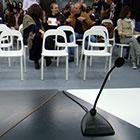
The Department of Architecture of University of Thessaly, organized a conference at 7-8-9 November 2025 with the title “Broken City” and subject the contemporary challenges for the architecture and urban environment where both undergraduate and postgraduate students, young graduates as well as phd candidates participated in a critical dialogue for the current issues of greek cities and the potential of architecture to become a tool for questioning and empowerment, shaping new collective dynamics and responses to social needs.
The conference created a framework of exchanging ideas in order to highlight the issues of our time, as well as new directions and proposals for cities and architecture through the lens of five topics:
- Surveillance and Repression
- Tourism, Gentrification and Urban Identity
- Architectural and Environmental Resilience
- Privatizations and common resources
- Visibility and Advocacy
As a closure a collective volume was created (conference proceedings) which includes texts of oral presentations presented.
Conference proceedings are available here.
Conference website: https://www.arch.uth.gr/spasmenipoli/

Lecture by Francesco Sartore, PhD candidate at the University of Padua, entitled "Visualizing Innsmouth: Digital Reconstruction, Immersive Environments, and the Limits of the Virtual" on Thursday 28/5/2026 at 14:00 in the Postgraduate Hall of the Department of Architecture, University of Thessaly.
What does it mean to give form to a place that was never meant to exist? Visualizing Innsmouth — a research project developed at the University of Padova in collaboration with Duke University — takes as its subject Innsmouth, Massachusetts, the fictional city conceived by H.P. Lovecraft in The Shadow Over Innsmouth (1936). Drawing on textual evidence, geographical and historical context, and Lovecraft's own autograph sketches, the project produced a navigable 3D reconstruction of the city, allowing users to retrace the protagonist's footsteps through streets that exist only on the page.
A discussion is then to be opened regarding the technical and perceptual limitations of the world of game engines and its surrounding ecosystem, beginning with those identified in this project. The aim is not to eliminate these limitations, but rather to explore how to work within and alongside them.
Bio
Francesco Sartore got the Master degree in Building Engineering and Architecture (UniPD) in 2024. He is a PhD candidate at the ICEA Department of the University of Padua. His doctoral research focuses on the possible uses of game engine software on the analysis, visualization and design assessments of the built environment. He did his master thesis in collaboration with Duke University Department of Art, Art History & Visual Studies. After graduation, he started his research activity on the T.E.A.C. Project (iNEST founded by PNRR) and is currently working on I_BRIDGE and SMUH projects in ICEA Department and Verona Municipality for the digitalization of documentary heritage using BIM tools. Alongside his academic path, he has cultivated an interest in drawing and 3D modeling for videogames and animation, enriching his interdisciplinary approach to game engine and 3D visualization research.
Re-Opening World Futures through Culture Landscapes. A Case in the Swiss Alps
Juli Osusky
Wedensday 27.5, 18.00 Patari Metaptychiakou
In times of climate crisis, we are witnessing the failures of modern planning and design in the diminishing of planetary futures. How, then, might we design otherwise? In this talk, I approach this question by examining culture landscapes in the Swiss Alps, where humans and non-humans together produce the conditions for mutual survival. By approaching landscapes as formed through water cycles, I speculate that designing cultural landscapes is a radically different practice from designing interventions; one that may open up alternative planetary futures in the Alps.
Juli Osusky is an Urbanist and Urban Designer based in Zurich, Switzerland, currently working at the Office for Urban Design of the city of Zurich. This talk is based on their master thesis in Architecture and Urbanism, which explores culture landscapes as a concept for dealing with water uncertainty in the alpine valley of Lumnezia, Switzerland, questioning the role of design. They hold degrees from TU Delft and ETH Zurich.
Within the framework of the course
PELION CHŌRA: Dissecting and Reweaving a Mountain
By The Observatory of the Countryside
Tutor: Metaxia Markaki
For online attendance contact memarkaki@uth.gr
Seminar: Contemporary Materialities of Architecture
Dry Construction, Bio-Based Materials and Contemporary Concrete Technologies
The Department of Architecture of the University of Thessaly is organizing an open lecture and discussion with professionals from the fields of construction and architecture, dedicated to contemporary architectural materialities and building technologies.
This event aims to introduce students to contemporary practices, technical applications and construction-related issues concerning durability, sustainability, material assemblies and passive fire protection in contemporary construction.
The thematic presentations will be given by:
-
Achileas Sakavos
Dry construction and lightweight building systems -
Petros Flampouris, architect
Bio-based materials and the use of natural materials in architecture -
Xanthippos Mitsios, civil engineer
Concrete and contemporary technologies of its application
Through presentations of projects, materials and technical solutions, the event will highlight the role of materiality in contemporary architectural practice and in the relationship between design and construction.
Friday, May 22, 2026
10:00
Amphitheatre, Department of Architecture, University of Thessaly
21/5/26 17:15 Amphitheatre
Christina Serifi (MOULD)
Architecture is Climate
Book Presentation & Lecture
Wednesday 20.5, 18.00
Post-graduate Loft & Online
Architecture is Climate reimagines the very foundations of architecture in an age of crises. Rejecting outdated paradigms of endless linear growth, technocratic fixes, and the separation of humans from nature, the project and the book argues that architecture must be fundamentally rethought—not as the design of objects, but as a practice entangled with climate, politics, history, and social justice. Through eight key themes—knowledge, economy, land, resources, infrastructure, work, policy, and culture—Architecture is Climate explores how climate breakdown reshapes every aspect of architectural thinking and doing. Drawing on diverse voices, and grounded examples from around the world, it offers not just a critique of the status quo but a vision of other possible architectures—and climates—already in the making.
Christina Serifi is an architect, researcher and co-founder of TiriLab an initiative exploring multicultural heritage, local technologies, and knowledges in rural northern Greece. She was previously Principal Researcher in Terreform, a New York Center for Advanced Urban Research, regarding indigenous knowledge, alternative educational models and self-sufficiency. Christina is also part of MOULD research collective. Their most recent project, Architecture is Climate, explores architecture's entanglement with ecological crisis. She is currently teaching and conducting research at the Institute for the History and Theory of Architecture and the City at TU Braunschweig.
Within the framework of the course PELION CHŌRA: Dissecting and Reweaving a Mountain
By The Observatory of the Countryside
Tutor: Metaxia Markaki
For online attendance contact memarkaki@uth.gr
Cultures of co-occupation
A kazáni, two types of milk, a stráta, and a monoculture in the Thessalian landscape.
Elina Letsiou
Wednesday 20/5, 14.00, Patari Metaptychiakou
DescriptionThe lecture begins in an apartment kitchen in Larissa—a kazáni, a clay pot, and a fermentation culture—and follows the milk on its journey: from the family’s household-grocery store to the paths of the Vlach transhumant herders and the monoculture fields of the Thessalian plain. Developing an informal material biography across five scales, we will discuss how architectural design can accommodate movement, transformation, and more-than-human co-occupants.
Elina Letsiou is an architect and PhD candidate at the Department of Architecture, University of Thessaly, under the supervision of Zissis Kotionis. Her research reframes the household as a micro-infrastructure of care —not as an architectural typology, but as a living entanglement of human and more-than-human forms of life, sustained through metabolic processes and embodied care. It articulates feminist care theory, posthumanist thought, and infrastructure studies, with milk fermentation as its empirical field across three temporalities: Neolithic Pindus, transhumant pastoralism, and contemporary Thessaly. She is co-editor and co-author of the book Assemblages of Terrestrial Accommodation (FRMK Editions, 2025). She has presented her research at international conferences, including ArchiBau.hr (2022) with the paper Care as a Material Doing, S.ARCH International (2021), and the Creative Europe / OPEN UP — DEVISINGS programme (2023). Her work has also been shown in European exhibitions. She graduated with distinction from the School of Architecture of the Aristotle University of Thessaloniki (2012) and completed with distinction the Postgraduate Programme in Architectural Design at the University of Thessaly (2015). She is the founder of L2 studio, an architectural practice based in Larissa and Thessaloniki.
The lecture takes place within the framework of the courses:
GEOGRAPHIES OF FOOD Tutor: Thaleia Marou
&
MACHINE IN THE GARDEN: Wanderings Through the Countryside
The Observatory of the Countryside Tutor: Metaxia Markaki
The Matter of Writing
A design workshop on the re-appropriation of writing
as part of the course IMAGE-WRITING (held by Fani Paraforou)
The workshop “The Matter of Writing” poses the following questions: What is the relationship between words and space, and how does the textual become synonymous with the plastic? Is it the gesture that transforms through the resistance of things, or is it the textual that presupposes an immaterial visibility of relationships and sequences? How does a practice take shape within the bipolarity of the immateriality of words and their material meta-translatability? Can an experience of reading and performance emerge within an expanded space-time of words, signs, and their materiality, such that they operate through it?
Writing constitutes a set of cultural and political elements that compose, sustain, and shape a serial field of fundamental patterns, aligning thought. On this surface, artistic practice opposes a language in which critique is directed in the reverse direction, against its guiding principles. It challenges and redraws. The workshop’s explorations, based on this bipolarity and the trilogy “index,” will be expressed through flows of materials, writings, rhizomes, and social contradictions. We will also examine how writing is transformed through material and lived processes, before the palimpsest of inscriptions and transcriptions permanently alters it in our eyes.
Tuesday, May 19, 2026 | 14:00
Graduate Program Lobby (ground floor)
ΜΙΝERALIZATIONS
built environments and their local geologies
Lydia Xynogala
Thursday 14/5, 13.00 Post-grad Loft
This talk will unfold through a series of sites in Greece the US and Germany whereby architecture and geology are entangled. By a close inspection of built artifacts I will discuss how methodologies, philosophical concepts, geological knowledge and history can be synthesized in writing and imagining new stories.
Lydia Xynogala (Dr.sc ETH) is an architect and writer working between Zurich and Athens; currently postdoc lecturer at the Academy of Architecture in Mendrisio and at the Academy of Art and Design in Karlsruhe. Her dissertation, on the history of mineral springs and baths in Greece, completed as a doctoral fellow at the gta Institute at ETH Zurich, was nominated for the ETH Medal and exhibited at gta exhibitions ETH Zurich, ZAZ Bellerive, and the Mendrisio Academy; currently preparing the manuscript coming out this fall by Park Books, Zurich.
Her architectural practice, ALOS, has been supported by fellowships from the New York Foundation for the Arts and the Onassis Foundation, and recognized with nominations and an award from the Greek Architecture Award. She has lectured internationally and her work and writings have been published at Future Anterior, MIT Thresholds, Log, e-flux architecture, Manifest Journal, Domus, gta papers , wallpaper* among other journals and book volumes. Previously, she has taught studios and seminars at ETH Zurich, Columbia GSAPP, The Cooper Union, City College NY and RPI. Xynogala holds architecture degrees from Princeton University, The Cooper Union, and the Bartlett, UCL.
Within the framework of the course
PELION CHŌRA: Dissecting and Reweaving a Mountain
By The Observatory of the Countryside
Tutor: Metaxia Markaki
For online attendance contact memarkaki@uth.gr
Lecture by Christos Filippidis Urban (Re)Design as a Counterinsurgency Tool: Constantinos Doxiadis in Vietnam
Thursday 14/5/2026 14:00-17:00 – Room Γ
Download the poster.
The lecture will take place online in the framework of the course:
Special Topics In Theory of Architecture Ii: Decolonising Architecture
Instructor: P. Phokaides, Ass. Prof. Dept. of Arch, UTh
Short bio:
Christos Filippidis is an adjunct lecturer at the Department of Architecture, University of Ioannina, Greece. Over the last years he has critically investigated issues related to urban securitization and militarization with a particular focus on counterinsurgency theories/practices and urban geopolitics.