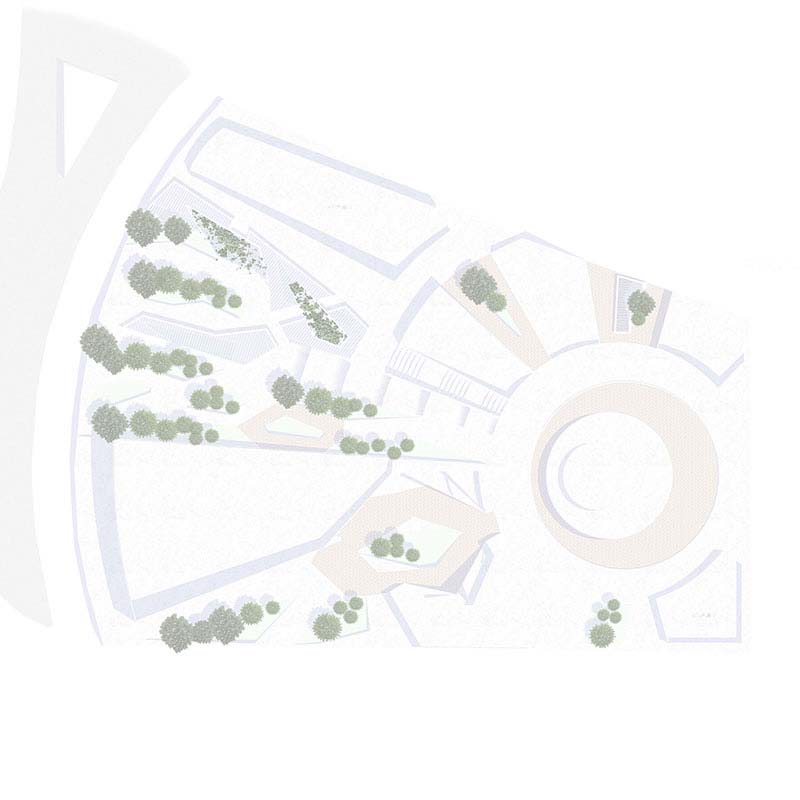
The Volos Astronomy and Space Society has long aspired to acquire its own observatory. There is a specific location in Agios Stefanos, Magnesia, that meets the criteria for establishing an observatory (a site at altitude, free from visual obstructions and light pollution). This area is located outside the urban planning boundaries of the village and is already being used by the Society. Some interventions have been made on the plot to accommodate the Society’s stargazing activities.
This project is based on the given data of the area and proposes the creation of a scientific complex. In addition to the operation of an enclosed observatory, it includes spaces designed to be publicly accessible, educational spots, open areas for recreation, rest, and outdoor stargazing.
The interior spaces consist of seven parts: an observatory, a museum-like building, and a building dedicated to educational purposes. There is also a cluster of structures connected by a corridor with indoor and outdoor access, including a cafe, a library/reading room, and a circulation hub. Finally, there is a collective residence building with a strong sense of privacy.
The outdoor spaces play a central role in the function of the complex, with key features including the stargazing platform and its accompanying tiered seating, a small square with shading structures, and green spaces that enhance the functions of the surrounding buildings. The planting in these areas further reinforces the sculptural quality of the overall composition.
To carry out the design, two different grid systems were used. The functional importance of the observatory—as the central building of the complex—was taken into account, with functions distributed across the volumes according to their level of public engagement. A consistent architectural language was maintained throughout the site.
The design outcome takes advantage of the dynamic geometry inherent in an observatory building. Here, the original form acts as both guide and center for the grid systems used in layout and planning. Its influence extends across the complex, not only in the morphology of the structures but also in the layout and spatial organization of the interiors.