


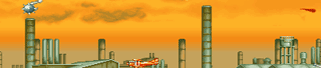



Cities of arcade games could be organized in the following conceptual typologies:
Motion Control Capture ContactFocusing on control in terms of movement, one could observe that an extended and recurrent phenomenon in videogames is the road (e.g. Turbo, Street Heat). More specifically, the road, as a motion track or as a channel into which action has to take place and cannot diverge from it. A plethora of arcade games have been developed under the scenario of a linear movement, usually depicting a vehicle travelling through or towards a city.
Michel de Certeau described that every story is a ‘travel story’, a ‘spatial practice’ (DE CERTEAU, 2011). Either by walking or navigating any other vehicle, or by becoming the vehicle himself, the player moves into a city which is becoming in its turn ‘a walking city’. This city creates a narrative based on a track. The player travels within it by observing abstracts of a blurry, indefinite and possibly endless city which solely makes itself apparent in the screen frame. According to De Certeau, this act of walking always suggests some kind of loss. For every movement taken, an abstract of space is lost. The city image appears to be an obscure ambient environment which is never actually fully observed due to the action of movement.
The urban gamespace in this context is transformed in a conduit of vehicles or even in a conduit of bodies. This city can be regarded as limitless, since its boundaries are never crossed and its distracting view creates a strong resemblance with innumerable other cities. Italo Calvino referred: “Traveling, you realize that differences are lost: each city takes to resembling all cities, places exchange their form, order, distances, a shapeless dust cloud invades the continents” (CALVINO, 1978. 137). The city is no longer a mere form, but the spatial relations developed in a motion-based context.
References:
CALVINO, Italo. Invisible Cities. Harcourt Brace Jovanovich, 1978.
DE CERTEAU, Michel. The Practice of Everyday Life. University of California Press, 2011.
The ground plan view has been extensively used by arcade videogames (e.g. Pac Man, Armored Car) offering the so called ‘supervision’ of the screen, and thence of the urban area. Its great success was based on the not so usual chance of viewing the city from above but also, on the possibility of exercising authority over the gamespace, an act which was imposed by the designer of the game.
This kind of granted power is actually a power of gaze, a gaze that bears the strength of a panoptic view, which according to Michel Foucault deviates the ‘subject seeing’ from the ‘object being seen’ (FOUCAULT, 1979. 200). This kind of supervision which is not only met in ground plans but also in any kind of sections or other non-static, camera dependent views, manifests gamespace as a corresponding territory of social control: the gamespace is an area of enclosure and the player is moved at a distance, acting like an invisible master. The panoptic space of the videogame is also capable of revealing multiple, parallel events, which is most of the times based on a road network or any other urban system with its own typology.
At the same time, the notion of control is expressed through restricted possibilities of choice concerning destination which are left to the player (usually left-right and down-up, e.g. Moon Patrol, Crazy Climber). These movement restrictions as well as restrictions due to the imperfection in the design of control mechanisms or other interactivity flaws (e.g. Firetruck), are the exact challenges and therefore, the exact
elements of interest during play which defined the quality of the game’s playability.
Yet, as every sense of control, issues of safety are raised. The well supervised space has always been connected to secure space, reminding of the phenomenon of CCTV observation system in public spaces. Hence, the digital city of videogames which was broadly permeated by violence narratives and other criminal acts (e.g. APB, Dead Connection) can be regarded as a place where danger is abolished under the ultimate supervision of a shopping mall. The videogame city in the first generation of videogames is a place of utmost security where violence can be acted out without taking any risk.
References:
FOUCAULT, Michel. Discipline and punish: the birth of the prison. Vintage Books, 1979.
The act of navigation in an arcade city acquires topological characteristics, since space is bound to a body in motion. The spatial organization is also met in terms of city fragments experienced separately during play. The digital city is a collage of urban abstracts visited, it is never experienced as a whole (e.g. Riding Hero, Art of Fighting). This fragmentation could be observed through the use of topological maps. Maps that reveal diagrammatic connections and encoded relations between represented places. Instead of offering a sense of orientation, they transform the city into an exploration vehicle.
The representation of the map is never the represented city in the same way Alfred Korzybski explained “the map is not the territory” (KORZYBSKI, 1994. 58). There is always an interpretational distance inserted through the act of representation. Thus, one could also observe a phenomenon of double representation: the representation of the already represented urban territory, a kind of encapsulated space, a space within the space of the game. The map is by far an instrument of successive interpretations, which result in the construction of a mental continuity of spatial experiences - a continuity between places of a real map, between game stages or between the payer’s experiences.
The composition and recognition of the provided urban fragments creates the impression of the city. In most cases, the components resemble the physical world, implanting in this way the existing impression of a real city in gamespace. These constructed impressions tend to familiarize the player with the digital environment through the use of a visual narrative (e.g. Super Pang, City Connection). This is actually an act of textual or visual representation which often includes references of famous landmarks or well-known locations. Transference of mental images, memories and other personalized information is taking place through the use of symbolism in design. Spatial stereotypes and clichés are far too common in gamespaces, while being at the same time a tool for intimacy evocation or direct identification (e.g. Cruis’n USA).
References:
KORZYBSKI, Alfred. Science and sanity: an introduction to non-Aristotelian systems. Institute of General Semantics, 1994.
The city experienced is usually an impenetrable city. It is basically composed of mapped surfaces which are never traversed. In most cases the city is a set, a theatrical scene behind the event, a kind of moving stage effect (e.g. Tokio). The urban environment represented usually remains an intact surrounding or spatial context into which events take place. All information behind the false building facades of the street views, are a series of subsided layers that give the illusion of a
pseudo 3d environment (e.g. My Hero). This phenomenon of subsidence is actually related to the subsidence of spatial information. This is also met in cases of actions taking place in one of the horizontal layers of the city, which usually are organized in patterns like the pedestrian, the underground or the rooftop layer (e.g. Dragon Master).
The few cases of surface penetration allow the interior view of a building, offering an additional scale of spatial comprehension (e.g. 005). Equally, in the few cases of surface contact (e.g. in platform games), the city transforms in a tool with the help of which the avatar’s body can move around. This resembles the idea of the medium, which according to Marshal McLuhan acts as a form of continuation of the player’s physical body (e.g. Numan Athletics). Wandering in this kind of urban environments transforms the city in a parkour practice, and its elements become the obstacles that determine the player’s performance (e.g. Strider 2). It is interesting to note that parkour is usually defined as the ‘art of movement’, a characteristic that well befits the playability nature of platform games.
This kind of cities is always represented through a body-centric point of view – a screen frame which is always attached to the avatar’s movement. The urban landscape is never visible, unless the avatar’s body inhabits it. This body is carrying the space with it, while becoming a camera itself (e.g. Bonanza Bros). The impression of the city is constructed in a cinematic way, like an aggregation of camera shots.
References:
MCLUHAN, Marshal. Understanding Media: The Extensions of Man. Gingko Press, 2003.