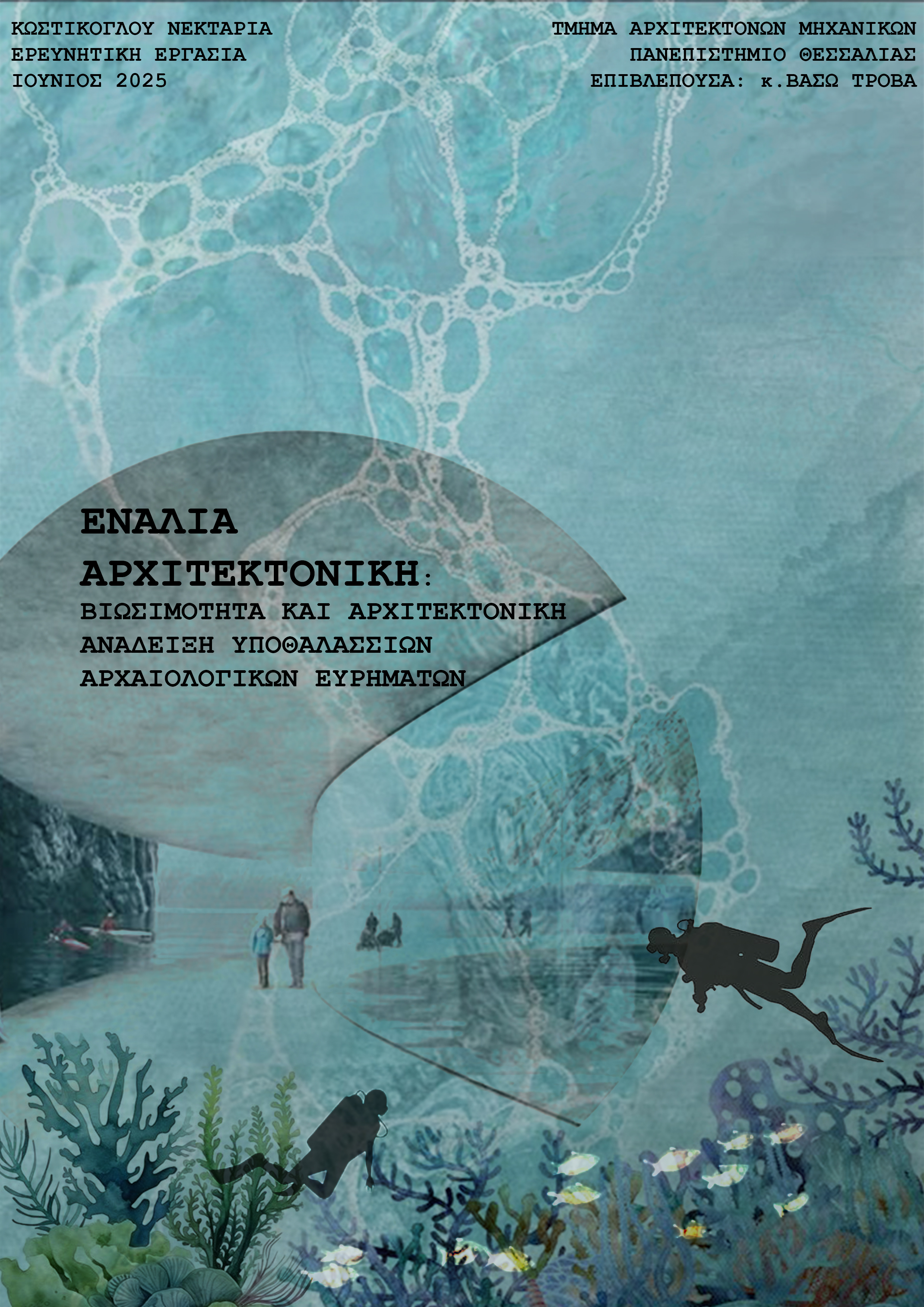
Underwater architecture: sustainability and architectural enhancement of submerged archaeological findings
Supervisor:
2025
KOSTIKOGLOU NEKTARIA
Supervisor:
2025
This research paper explores the dynamic relationship between the aquatic environment and architecture through the lens of underwater cultural heritage. The broader theoretical and architectural study was inspired by personal experience gained through participation in underwater educational activities at the ancient naval port of Aegina.
The study is structured around three main axes: a historical overview of water-based architecture (as revealed through humanity’s longstanding coexistence with aquatic environments), the challenge of sustainably preserving archaeological findings in marine settings, and the promotion of these findings in their natural environment through the implementation of underwater museums.
The historical reflection on water architecture highlights the enduring interaction between humans and water, from prehistoric lake settlements to modern utopian visions of floating and underwater cities. Particular emphasis is placed on the work and vision of Jacques Rougerie. His approach to aquarchitecture, alongside the fundamental principles of biomimicry and sustainability, laid the groundwork for contemporary architecture within marine environments.
The protection of underwater cultural heritage remains a critical issue that demands both scientific expertise and architectural sensitivity. Artifacts located in underwater contexts are exposed to continuous natural degradation. Therefore, it is imperative to apply conservation methods that respect both the authenticity of the findings and the natural environment in which they exist. The principle of in situ preservation, as established by international organizations, proves to be vital for the sustainable protection of these findings in their original setting. The study also refers to modern technological tools used in the conservation of archaeologically significant objects.
Underwater museums offer a unique experience to visitors and contribute significantly to the sustainable preservation of cultural heritage. The presentation of examples of contemporary underwater museums highlights the contribution of architectural design to the cultural promotion and protection of findings in their natural context. Four characteristic case studies—the Peristera Underwater Museum in Alonissos, the Museo Subacuático de Arte in Mexico, the Underwater Archaeological Park of Baia in Italy, and the Baiheliang Underwater Museum in China—illustrate different approaches to the challenges of accessibility and protection of invaluable archaeological artifacts.
Water architecture embodies principles of sustainability and environmental respect. Its role is therefore pivotal in both the preservation and the promotion of underwater cultural heritage.
Abstract