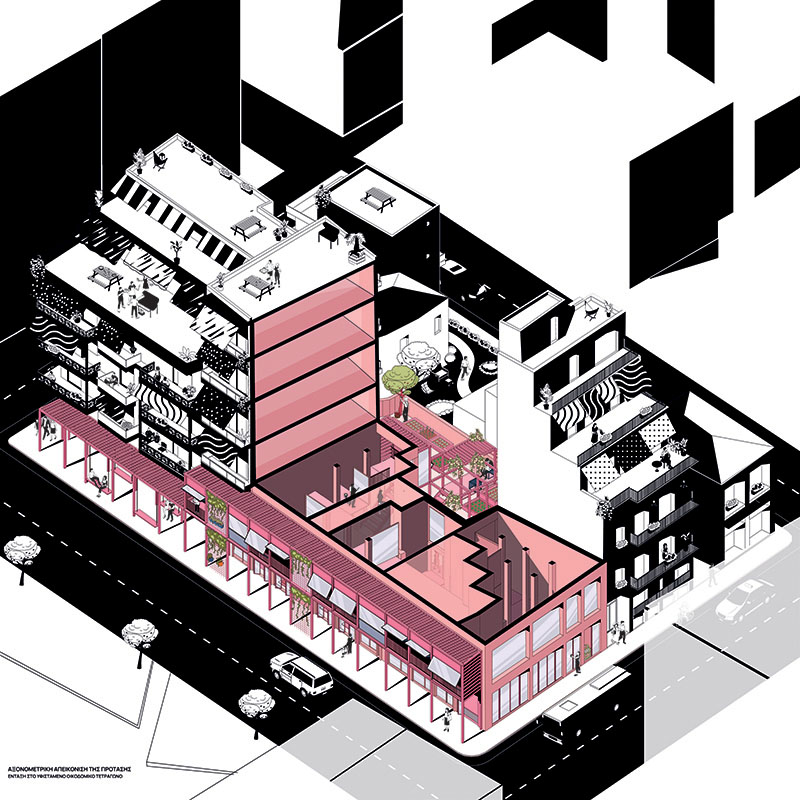
The diploma thesis “Catalysts: Composing Everyday Encounters” explores the role of the ground floor as an intermediate zone between building and city, and its potential to support everyday presence, lingering, and social interaction. The research originates from the observation of a gradual weakening of public life alongside the presence of inactive ground-floor spaces which, despite their direct relationship with the street, remain disconnected from the everyday life of the neighbourhood.
The theoretical investigation focuses on public life, the ground floor as an active urban interface, the notion of the threshold, the kafeneio as a space of social gathering, and the significance of human scale. The research subsequently moves to the neighbourhood of Metamorfosi in Volos, where field observation, conversations with residents, and the mapping of ground-floor uses and inactive spaces lead to the selection of three ground-floor spaces within the same urban block as the field for the design investigation.
Rather than treating the three ground floors as independent interventions, the proposal approaches them as parts of a shared spatial system connecting the street, the pavement, the interior spaces, and the common courtyard.
Through a common grid, a system of platforms, intermediate zones, and adaptable boundaries, the proposal creates different possibilities for movement, lingering, use, and participation. The architectural intervention does not attempt to prescribe social encounters; instead, it seeks to establish the spatial conditions and “occasions” through which encounters may emerge as part of everyday life.
Keywords: inactive ground floors, urban threshold, public life, social interaction, adaptability