Supervisors:
2026
This diploma thesis investigates the design of a care environment for people living with autoimmune diseases, not as a medical facility focused on cure, but as a place of temporary retreat, relief, rest, and restoration of physical and psychological balance. The project originates from the understanding of chronic illness as a condition that fundamentally alters an individual’s relationship with their own body, as well as the ways in which they organize everyday life, manage energy, relate to others, and experience space.
Therefore, the research moves beyond the medical diagnosis itself and focuses on the lived experience of illness and the needs that emerge from it: withdrawal, pause, acceptance, community, and environments that support gentle engagement with daily life. Through questionnaires, theoretical investigation, scientific research, and spatial analysis, the study identifies that the needs of people living with chronic conditions are not merely psychological or social, but are closely connected to bodily variability, difficulties in stress regulation, persistent fatigue, and the need to regain a sense of safety.
Consequently, the design objective shifts from the notion of treatment to that of care. Rather than promising recovery, the proposed environment seeks to support the body in its effort to decompress, reconnect with natural rhythms, and inhabit itself with greater ease and relief. Contemporary scientific evidence regarding the relationship between nature, stress, inflammation, and social connectedness further reinforces the argument that the spatial context of everyday life is not neutral, but acts as an active regulator of physical and psychological wellbeing.
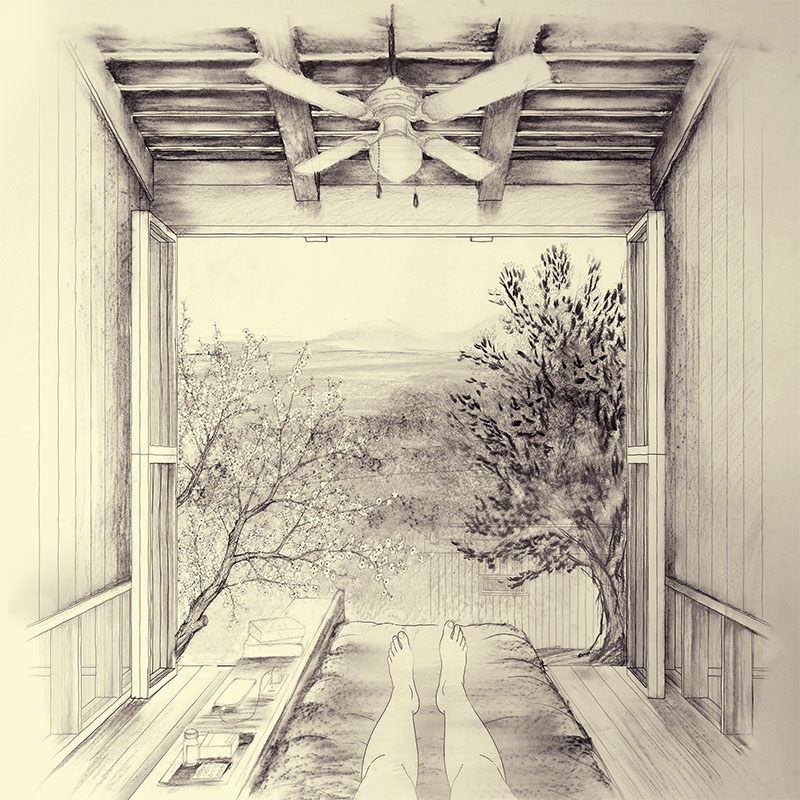
The proposal is situated in South Pelion, within an olive grove in the area of Loggari, surrounded by oak and chestnut forests, and is conceived as a dispersed landscape of care rather than a single institutional building. Accommodation, communal life, rest, movement, and everyday care practices are distributed throughout the site, forming a small-scale care settlement embedded in the landscape. The terrain, vegetation, shade, sea views, sunlight, wind, and local microclimate operate as primary design generators.
As a central typological reference, the project draws upon the traditional sheepfold and livestock enclosure, understood both as a form of vernacular architecture and as an architecture of memory. Its characteristics -stone foundations, lightweight superstructures, openness, clear territorial definition, and a direct relationship with the ground- are reinterpreted into a small care pocket. Within this framework, nature does not merely surround the architecture as scenery; it becomes the primary medium through which care is experienced and enacted.
Keywords: Autoimmune disease · care · regulation · nature · Pelion