Supervisor:
2026
The present diploma thesis investigates the design of a temporary, flexible preschool education unit, as a response to the increased needs that emerged following the implementation of compulsory two-year preschool education. The starting point of the study is the documentation of the existing problem of housing kindergartens, with particular emphasis on the use of container-type classrooms, as well as the analysis of the institutional and spatial constraints that determine their design.
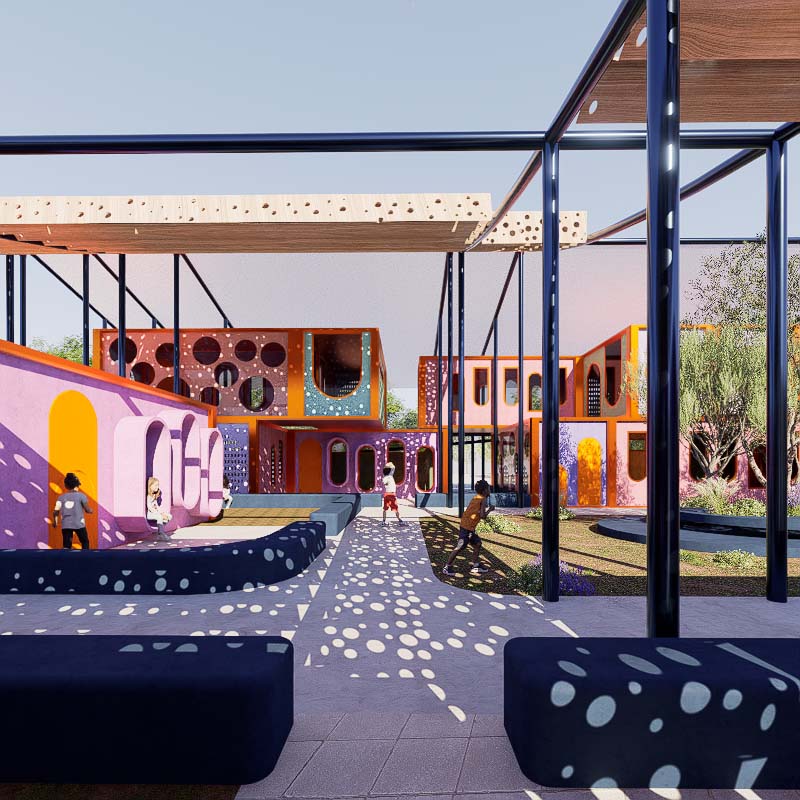
The thesis approaches the school not as an isolated building, but as a small-scale “neighborhood”, organized through distinct spatial units corresponding to the child’s fundamental experiences: the outer neighborhood, nature, play, learning, and the inner neighborhood. These concepts function as both conceptual and spatial tools, guiding the configuration of educational and outdoor spaces and facilitating the smooth transition of the child from the broader environment to the protected school setting.
On a theoretical level, the study draws references from the architectural thinking of Takis Zenetos and Dimitris Pikionis, focusing on the notion of the school community, flexibility, and the experiential relationship with space. On a design level, a modular system of school classrooms based on standardized ISO container units is proposed, allowing for easy repetition, relocation, and adaptation to different sites and conditions.
Within the framework of the study, individual design components of the school unit are examined in detail. Specifically, the classrooms are studied as the primary functional units, the façades as transitional filters between interior and exterior space, as well as the roofing and shading systems. Particular emphasis is placed on folding as a principle of movable shading, which allows outdoor spaces to adapt to changing climatic conditions. At the same time, the role of schoolyards is explored as an integral part of the educational process and the child’s daily experience.
The study concludes with the formulation of an integrated school unit capable of horizontal and vertical expansion, incorporating outdoor and semi-outdoor spaces, courtyards, and shading systems. The aim of the proposal is to create a functional, human-centered, and pedagogically high-quality environment that responds to the contemporary needs of preschool education, while maintaining its temporary and flexible character.
Keywords: Mandatory education, container, facades, playgrounds, folding shade canopy