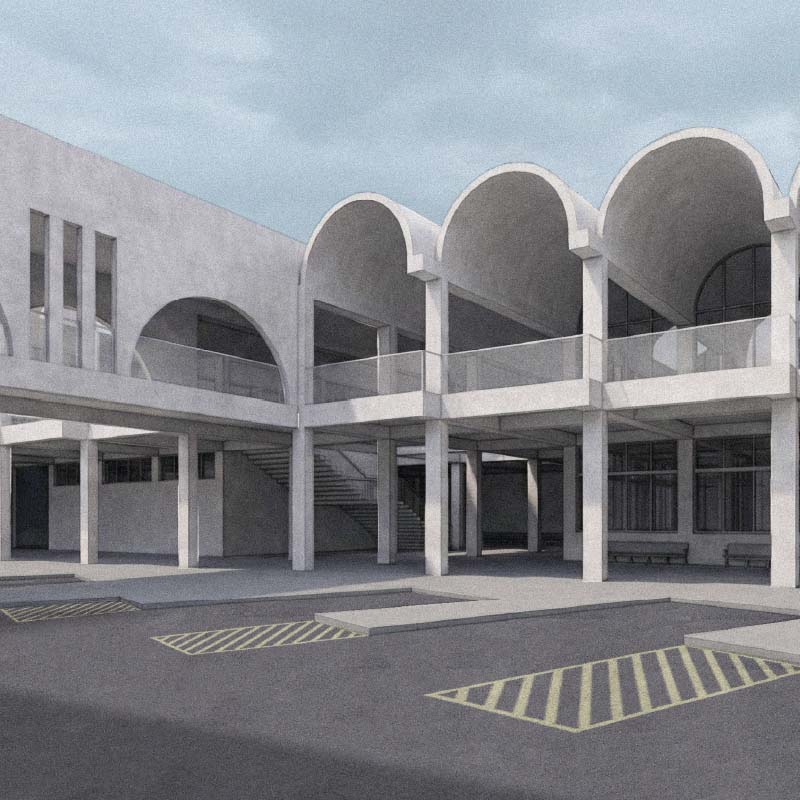
An intercity bus station functions as a pivotal urban node that serves the commuting needs of the local population, the workforce, and visitors alike. It constitutes the primary mode of inland transportation between urban centers and remains vital for regional connectivity. Rhodes, as the largest island and the administrative capital of the Dodecanese, represents an essential transit hub. Its strategic role is further amplified by the presence of an airport and its maritime connections with the surrounding islands, making the establishment of a functional bus terminal a matter of paramount importance.
The existing Intercity bus station in Rhodes is currently limited to a ticket office, whereas bus departures occur directly from the pavement of Averof Street. This arrangement significantly obstructs the city’s traffic flow and results in a lack of adequate waiting areas for the traveling public. Furthermore, a secondary critical issue involves the fragmentation of services, as departure platforms are scattered at locations distant from the central departure point. The fact that administrative offices are similarly detached further complicates operations. Resolving these multifaceted inefficiencies is the primary objective of this thesis.
Regarding the siting of the proposed terminal, the building block situated between the ports of Rhodes, specifically at the junction of Australias and Canada Streets, has been selected. This thesis aims to design an integrated infrastructure that consolidates all necessary terminal functions into a unified building. The architectural synthesis draws inspiration from the Dodecanesian heritage, adopting the arch as the fundamental design element. This morphological feature is utilized in its various expressions, in both recent and older buildings.
Key Words : Transport Hub, Bus, Turning Radius, Dodecanesian Architecture, Arch