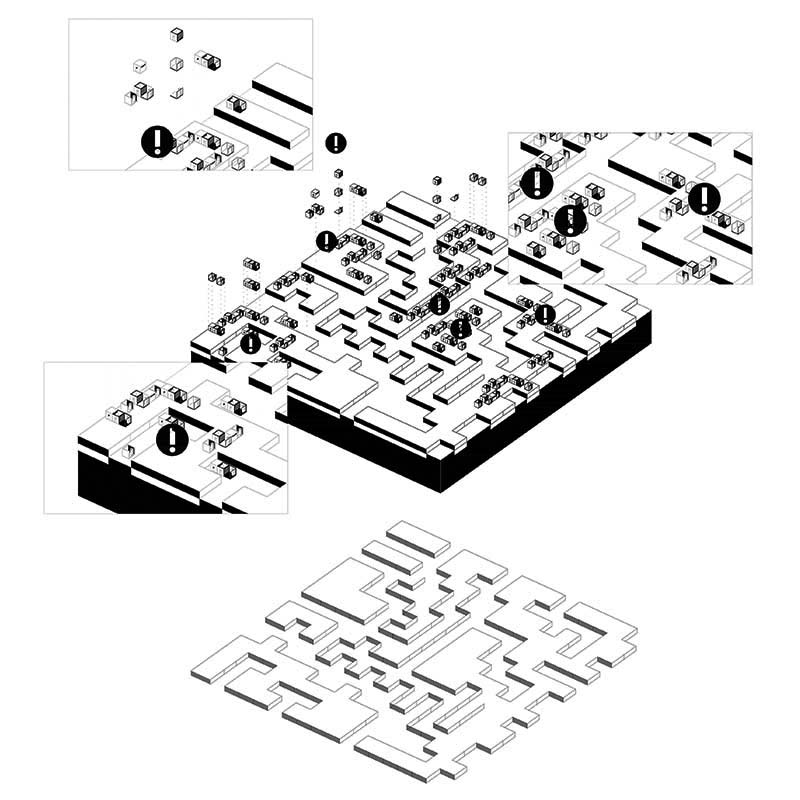
This thesis investigates the concept of “panic rooms” at multiple scales, addressing both their role as private refuges and their potential as dynamic spatial elements within the public realm of the contemporary urban environment. The theoretical framework draws upon Stephen Macek’s Urban Nightmares, as well as dystopian architectural precedents such as the Cabrini-Green housing project in Chicago and the Bijlmermeer in Amsterdam. In addition, the residential studies of Peter Eisenman (House I, House II, House VI) are examined as references to spatial experimentation and the disruption of conventional domestic typologies.
The research is structured in three stages. The first stage involves interviews with individuals experiencing panic disorders, conducted in collaboration with a mental health professional, with the aim of documenting lived experiences, understanding specific needs, and developing personalized spatial proposals. For ethical reasons, all interviews remain anonymous. The second stage focuses on the design of a catalogue of five rooms inspired by water and gardens, recognized as therapeutic media that foster calmness, restoration, and a sense of safety. Finally, the third stage proposes the integration of these rooms into the urban fabric, with a specific application in the Gothic Quarter of Barcelona. Within this context, the rooms are reinterpreted as spatial nodes of cooling, protection, and psychological relief, contributing to the improvement of urban life quality and introducing new forms of public care in the city.