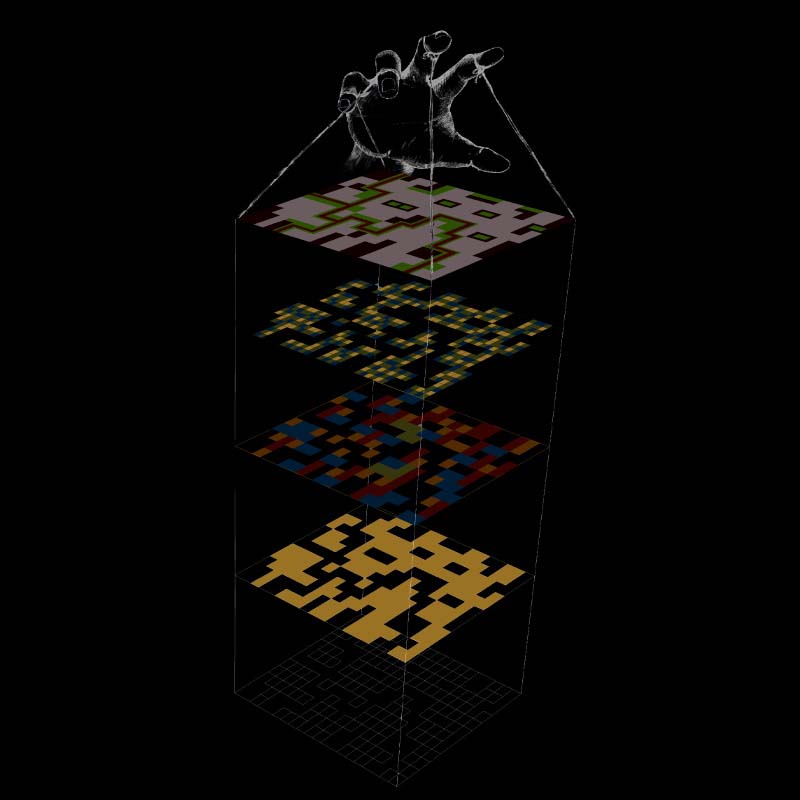
The diploma thesis titled Dynamic Cluster Housingfocuses on exploring new methods of housing production through algorithmic and parametric tools. The aim of the research is to develop a system that does not generate a single fixed solution, but rather a spectrum of possible spatial configurations, capable of adapting to different needs and conditions.
The theoretical starting point was the theory of space syntax, as presented in The Social Logic of Spaceby Hillier and Hanson. This methodology demonstrated how spatial arrangement influences social interaction, providing a theoretical foundation for the development of a dynamic housing system.
Subsequently, polyomino systems were developed and tested as the main compositional tool. Through iterative experimentation in Grasshopper for Rhino, geometric rules were defined (e.g., free edges, golden rectangle proportions) to produce valid forms with functional density and intermediate spaces. The process involved continuous evaluation and modification of parameters to avoid dead-end or excessively compact configurations.
The experiments were carried out on a 100×100 m plot, where multiple compositions with different placement rules were investigated. The resulting solutions were organized into typologies with specific logics for the distribution of wet areas, living spaces, and courtyards. The analysis identified 5–6 alternative floor plans, while in larger typologies the possibility of adding an additional floor was also examined.
The thesis highlights a new design approach, where the architect does not produce a single final solution but rather a spectrum of options, based on principles of sustainability, bioclimatic architecture, and collaborative design. This model can serve as a proposal for the reinhabitation of depopulated areas such as Thrace and the Aegean islands, for meeting housing needs after natural disasters or migration flows, and for creating settlements with equitable property distribution and improved quality of life.