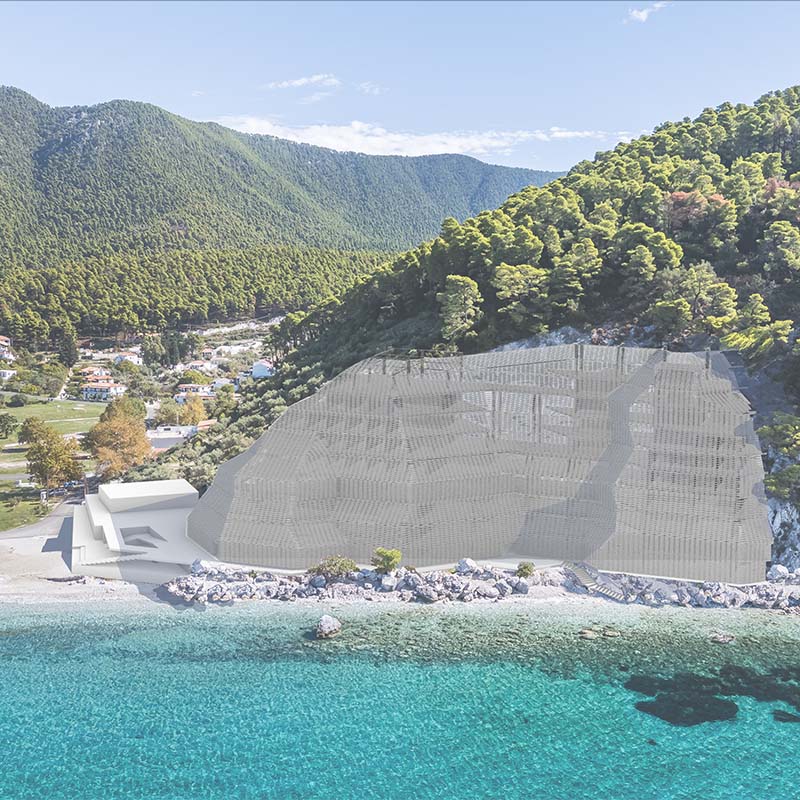
In Neo Klima Skopelos, in the coastal area of Ηovolo, a multifunctional building is proposed, aiming to serve as a meeting point for diverse forms of habitation and use, addressing the needs of permanent, temporary, and visiting residents of the island.
The architectural proposal is developed within a landscape marked by signs of former quarrying activity. In a place already altered by human intervention, the building does not seek to cover the wound but to coexist with it, proposing a new mode of presence within the landscape.
The building is organized as a unified complex of multiple uses. It includes residential spaces, cultural and social facilities, areas for education, sports, and dining, as well as functions supporting the local economy, such as offices and rental spaces. The coexistence of these uses within the same shell attempts to reconsider the relationship between visitor and place, proposing a hybrid model of habitation and hospitality that responds to the particularities of island life. Morphologically, the building develops following the contour lines of the terrain, integrating into the geometry of the rocky landscape. Its exterior skin is designed as a continuation of the rock, using local stone and inclined planes. It consists exclusively of fixed stone louvers, arranged rhythmically, allowing light and shadow to alternate, creating a filter that harmonizes with the natural topography and enhancing the dialogue with the materiality and memories of the place. The building’s form appears at times prominently and at others recedes into the environment, maintaining a continuous, dynamic relationship with it.
The proposal does not aim to impose a new aesthetic identity but to stand with modesty and awareness within the changing landscape, functioning as an intermediary space between rock and human.