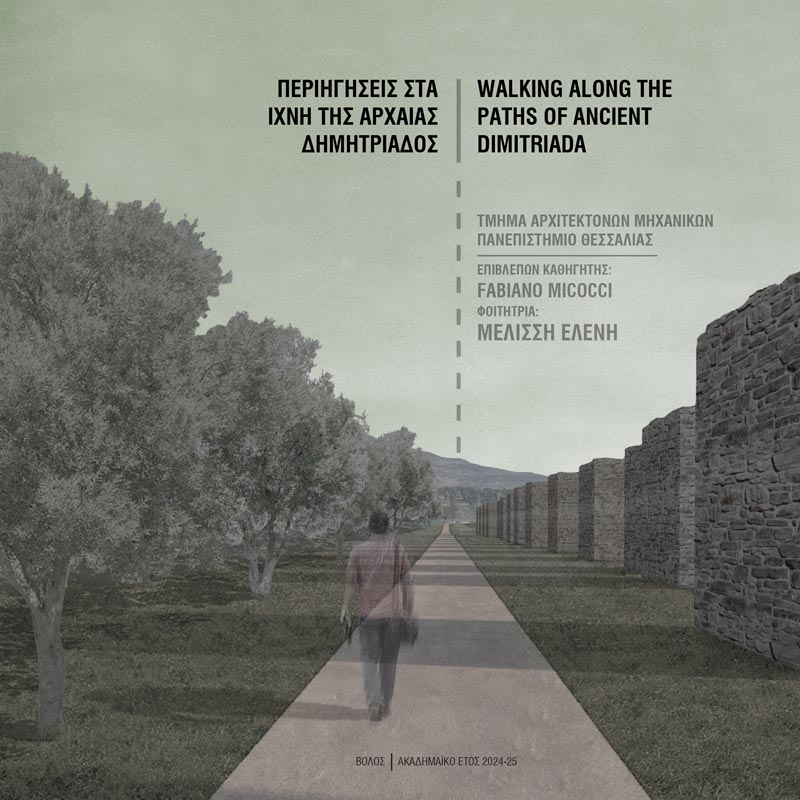
This thesis focuses on the study of the archaeological site of Ancient Demetriada and the design of a spatial experience, through which visitors are invited to get to know the “imprints” of the ancient city, from antiquity to the present day, as well as to navigate among traces that are no longer visible, but whose existence has been revealed through studies and their mapping onto the modern city. Ancient Demetriada is located south of the port of Volos, at a distance of 1.5 km, in the inner part of the Paga-setic Gulf, and was one of the most important cities of Thessaly during the Hellenistic period, owing to its strategic geographical position. Today, the ruins of the ancient city are located in the southeastern periphery of the urban complex of the Municipality of Volos, between the inhabited areas of Aivaliotika and Nees Pagases. The most important of the surviving monuments are the Ancient Theatre, the Aq-ueduct and the Palace, which are located on either side of Athens Street, a major urban axiςof the city of Volos, which crosses the area and runs in front of the ancient theatre. The intention was to achieve unification of the main monuments, both among themselves and with the architectural remains found in the northern and southern parts of the area. The starting point of the spatial tour is the kiosk, an information, education and reception area, which is planned to be placed in the site where the Theatre is located. In addition, near the Palace area, it is planned to create a museum space, where visitors are informed about the life and functioning of the ancient city, as it was depicted in tombstones discovered through excavations, through the permanent and temporary exhibition areas. he routes designed for the exploration of the space were based on the concept of a straight line, with reference to the rectilin-ear arrangement of the columns, the rectilinear axes that constituted the Hippodamian system, on the basis of which the ancient city was structured, as well as the sinuous perimeter of the ancient wall. The columns of the Aqueduct were the starting point for the conceptual basis for the design of the kiosk.