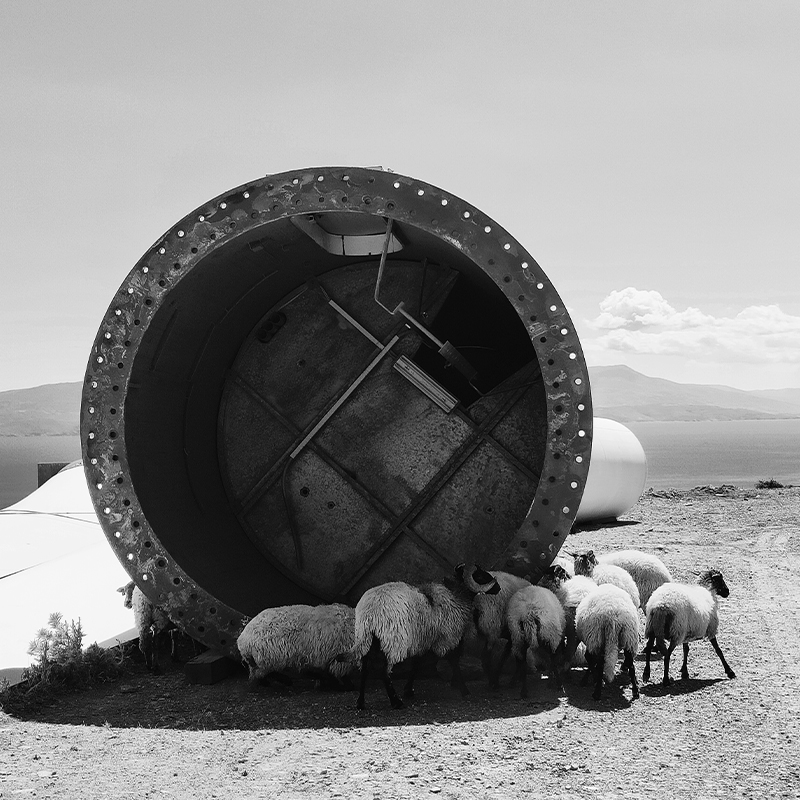
We are set in the mountainous rural landscape of Kafireas or more commonly known as Cavo d’Oro, in South Euboea. The central theme of the research deals with the current situation in the area, with the two main activities being livestock farming and the wind industry, which may not be directly related, but have a common concern of caring, with the inhabitants of the wider area professionally engaged in "Tending Sheep, Goats and Wind Turbines". Man-Animal-Machine coexist in the landscape, or at least they try to as the wind industry dramatically affects the place, turning it into a machine landscape (Young L.) where each of us is an intruder in an architecture that has left us behind.
Thoughts about embodied experience in the landscape are therefore generated, thoughts about issues of power, claim and politics of the land. Thoughts about the present and future of the land, thoughts about a possible post-Anthropocene era scenario where technology 'calculates', shapes and constructs our world, having a universal influence on the environment, with humans watching and intervening when they need to care for the machine, like a farmer watching and caring for his herd and land for as long as it is still in his hands.
By examining the extent of anthropocentric interventions, which become geological forces and shape the identity of the landscape, the power relations between the subjects involved, human and non-human, the forms of political assertion through ecological social movements, and the technological “invasion” redefining the relationship between humans, technology and nature are analyzed. Under the new conditions, we need to redefine the narratives, models and tools of architecture and thus any act of knowledge should, first and foremost, be considered an act of care, focusing on the potential for long-term survival on the planet, the ground we walk, act and talk on, rather than the achievement of short-term desires.