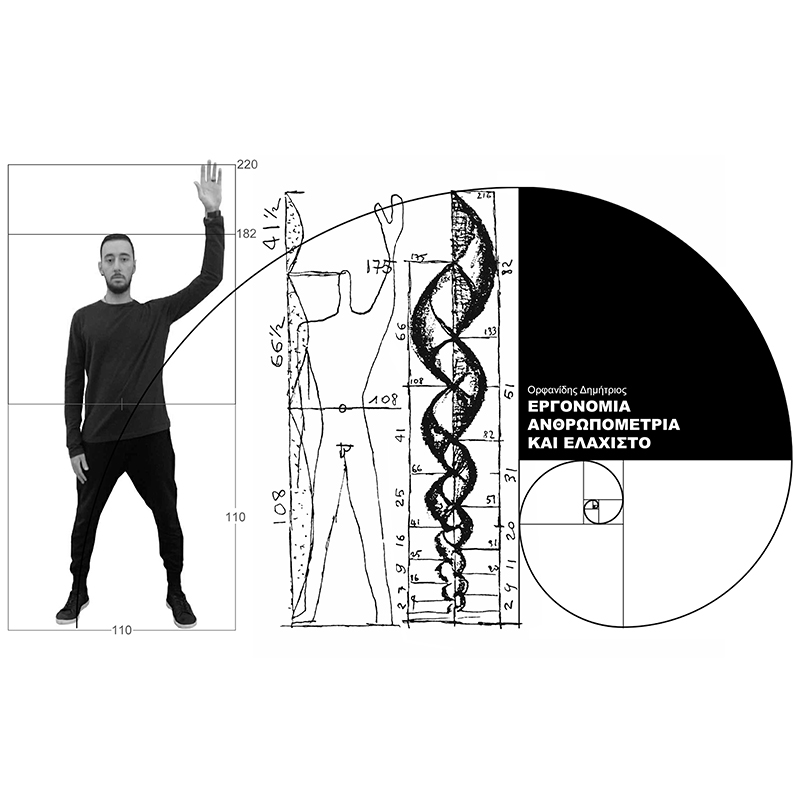
This research paper focuses on investigating contemporary ergonomic and anthropometric standards, as well as the importance of ergonomics and anthropometry in the design of minimal habitation structures. The study was inspired by the question of whether a very small house can be ergonomic. Consequently, it explores whether minimal habitation structures exist that, based on my own dimensions, can provide the necessary comfort, functionality, and safety despite their limited size.
The research is divided into three main sections. It begins with the theory and analysis of ergonomics and anthropometry, emphasizing the crucial role these fields play in achieving the sustainability of a space. This is followed by an examination of specific examples of very small homes, whose dimensions adhere to the anthropometry of my body, to evaluate the functionality of ergonomics in each case.
In the ergonomics chapter, efforts are made to clarify the term and relate it to anthropometry and other sciences. The role of ergonomics in the design process and scientific development is studied, with examples of ergonomic standards documented. The analysis then delves into seating ergonomics and examines certain modern revisions of ergonomic standards based on technological advancements.
The second chapter focuses on the study of anthropometric systems. After presenting the historical evolution of anthropometry over the years, the works of two significant architects of the last century, Le Corbusier and Neufert, whose contributions form the basis of modern anthropometric standards, are utilized.
Following the analysis and comparison of the anthropometric systems of these two architects, the next chapter seeks to demonstrate their relevance by comparing my own dimensions with those of each system. To better compile the results, comparisons and evaluations are conducted using tables that include a series of additional individual anthropometric measurements. This chapter is further enriched with additional comparisons of famous anthropometric models.
Next is the analysis of three minimal habitation structures, whose designs are based on the anthropometric standards of the system that best matches my dimensions. The aim is to highlight the virtues that ergonomic and anthropometric solutions bring to the design of these homes. For the purposes of the research, the residences Cabanon, Keret House, and Diogenes were used.
The overall analysis contributed to the formulation of well-documented conclusions regarding the relevance and use of anthropometric systems, as well as highlighting the paramount importance of ergonomics and anthropometry in architectural design.