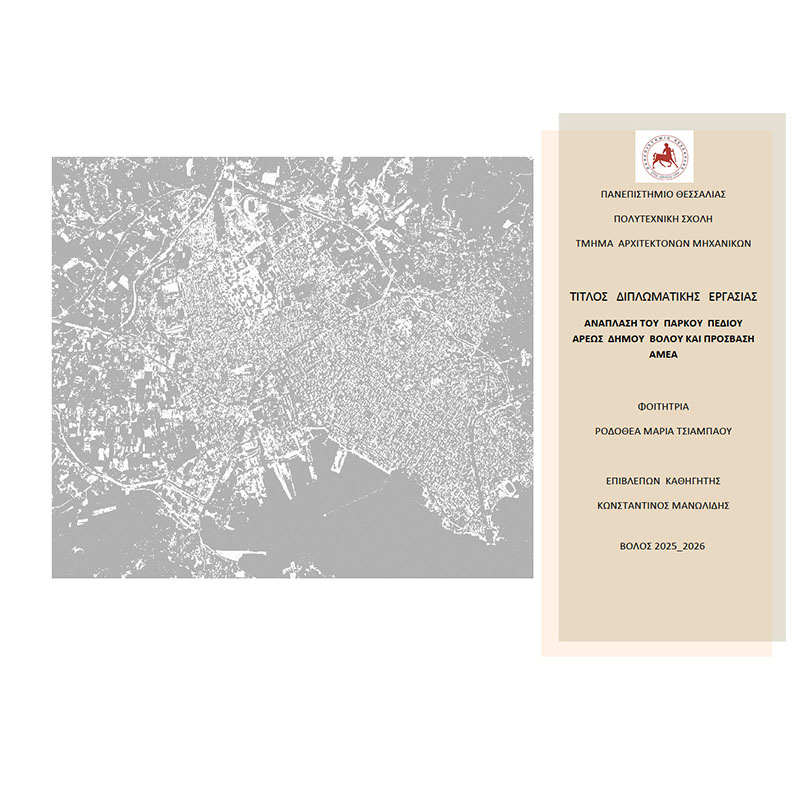
The present diploma thesis addresses the architectural and urban regeneration of Pedion tou Areos in the Neapolis area of Volos, aiming to transform it into a modern, regional pole of greenery, culture, and recreation. Due to its pivotal location adjacent to the School of Engineering of the University of Thessaly and the coastal front, the study area presents strong strategic interest as well as significant environmental challenges.
The design proposal introduces a dynamic, organic gesture, central to which is the creation of an artificial lake-moat surrounding a central "island" of activities. Based on the principles of bioclimatic design and Nature-Based Solutions (NBS), the water element is combined with dense Mediterranean plantings and the use of water-resistant natural stones (hard schists and basalts) applied both to the waterfront configurations and the facades of the building facilities.
Particular emphasis is placed on the principle of Universal Design (Design for All), ensuring the autonomous and safe movement of people with disabilities and reduced mobility throughout the park via a unified network of tactile paving for the visually impaired, gentle slope ramps, and accessible urban equipment. At the same time, the traffic issue is resolved through an organized internal network of gentle mobility (pedestrian paths, bicycle lanes) and the undergrounding of parking needs on the Port Authority of Volos (OLV) plot using a waterproof flood-protection tank.
The final result synthesizes a "Smart & Sponge Park", capable of shielding the area against extreme flooding events, reducing the urban heat island effect, and offering a vital public space of high aesthetics and social equity for the city of Volos.
Keywords: urban design, regeneration, bioclimatic landscape architecture, public space, universal accessibility, tactile paving, disabled access (PwD), water element, resilient cities (Sponge Park), Volos.