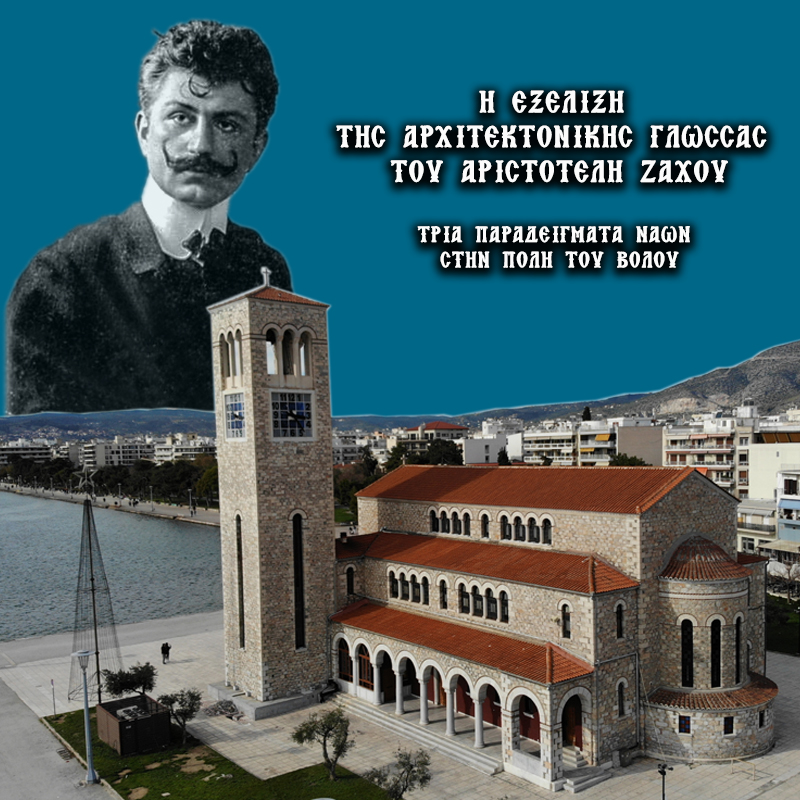
Aristotle Zachos is one of the most important Greek architects of the 20th century. He was a dominant personality of the architecture of the interwar period and the founder of the principles of modernity in Greece, still under Turkish rule, which was searching for its national identity.
He was born in Kastoria in 1871. He was the third of the five sons of the teacher and merchant Athanasios Zachos from Siatista. The Zachos family was wealthy, since they were still involved in the fur trade from the 18th century. They also had intense social and patriotic activity in Macedonia and Volos.
Aristotle Zachos finished high school in the Monastery of Macedonia and early showed his inclination towards architecture. He studied at the three most important technical universities in Germany, Munich, Stuttgart and Karlsruhe, learning the new trends in art, such as Jugendstil. He interrupted his studies to return to Greece in order to fight in the Unfortunate War of 1897 and tasted the National Divide. While still a student he worked in the office of the theoretical and antiquarian architect Josef Durm designing important public buildings in Germany.
When he returned to Greece, he found it difficult to work as his participations in architectural competitions had strong characteristics of new trends in Europe. Although he was awarded in Europe, his works were not implemented either at all or modified from their original composition as they were not easily accepted in the conservative architecture of the Greek society.
Traveling throughout free and underserved Greece, he searched for and captured with sketches and photographs the original Greek folk architecture, which, after assimilating, he adapted it to modern reality by combining it with the new currents he had brought from the West, carrying out many important projects until his death in 1939.
This research paper briefly presents the great architectural work of Aristotle Zachos and mainly the church buildings located in the wider Greek area and especially in the city of Volos. The purpose of the research is to highlight his work and the evolution of his language architecture that established him as the most important forerunner of Greek-centric modernism.