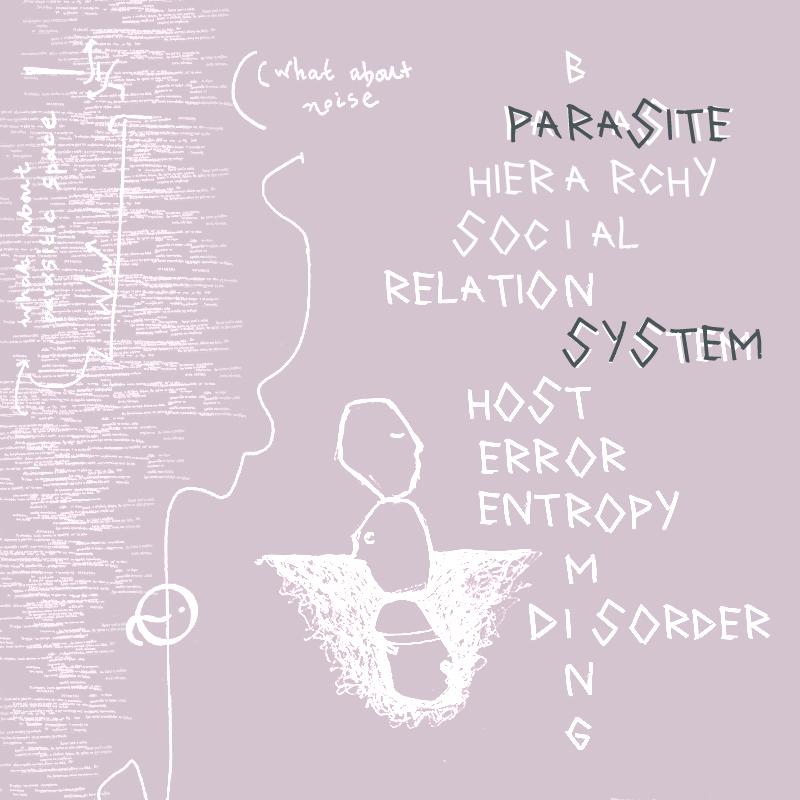
How does the parasite interact with the system that nourishes it? Is the disorder a "catastrophe" or a mechanism for evolution? In line with Michel Serres' philosophical approach, this research topic traces the concept of the parasite as a means of transforming the complex, recomposing and understanding social interactions. The existence of a parasite automatically implies the presence of its host, which is why any parasitic relationship is considered an integrated and at the same time a disturbed whole. From the lexicon of concepts in chapter one, where the portrait of the parasite is gradually formed, to the perpetual cycle of systems in chapter two, we discover the ambiguity of error as both an intrusive and fundamental condition. In order to describe this contradiction that constitutes the dipole, integrated-disrupted, we will invoke Ulrich, Pandora, Alice and Geon-sae as the composition of an allegorical parade of fictional characters. Can there be order without its subversion? In chapter three, the film Parasite becomes an example of audio and spatial expressions of error. What is the role of noise, in the various incidents? After the invasion is given substance by ringing bells and falling stones, the vertical narrative of social hierarchy is modelled through the division into the levels of basement, semi-basement, ground floor. Finally, it is examined what happens where the three cases mentioned above are condensed. How does the perspective of space change in horizontal set narrative? What data do we obtain in the case of public space when the parasite is not banished from the equation but is included? The fault becomes the moment the system is ruptured to be reborn, but what remains when the cycle of disturbance is closed? The research suggests an alternative interpretation of ecosystems, not as closed fields, but as universes open to noise, disorder and invention.