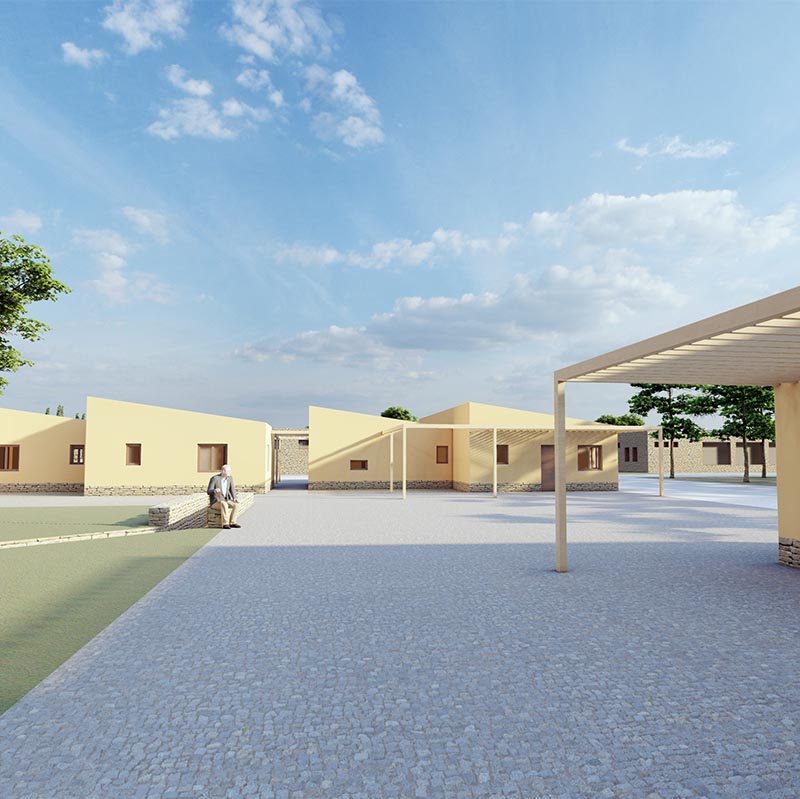
This diploma thesis explores the development of a senior cohousing community in Efxeinoupoli, Magnesia, as an alternative housing model to conventional elderly care facilities. The need for new forms of living arises from population ageing, the gradual weakening of traditional family structures, and the limited capacity of existing welfare systems to adequately address the contemporary needs of older adults.
The theoretical framework examines the historical evolution of cohousing and retirement communities, from the first organized retirement settlements in the United States to contemporary European examples. In addition, the study investigates the social, economic, and demographic conditions that make alternative housing models for older adults increasingly relevant in Greece.
The proposed community is based on the principles of autonomy, mutual support, active ageing, and social participation. Rather than treating older adults as passive recipients of care, the project envisions them as active members of a community who participate in everyday activities, collective decision-making, and the shaping of their living environment. Shared facilities, cultural activities, productive landscapes, educational initiatives, and connections with the local community are integrated into the proposal in order to strengthen social cohesion and improve quality of life.
The selection of Efxeinoupoli as the project site is closely linked to the historical and social identity of the settlement. Founded by refugee populations and shaped through collective organization and solidarity, the settlement provides a meaningful context for the implementation of a contemporary community-based living model. The architectural proposal seeks to redefine the relationship between housing and care by creating an environment where independence coexists with collective living, support networks, and active participation in community life.
Keywords: Cohousing, Older Adults, Collective Housing, Active Ageing, Community