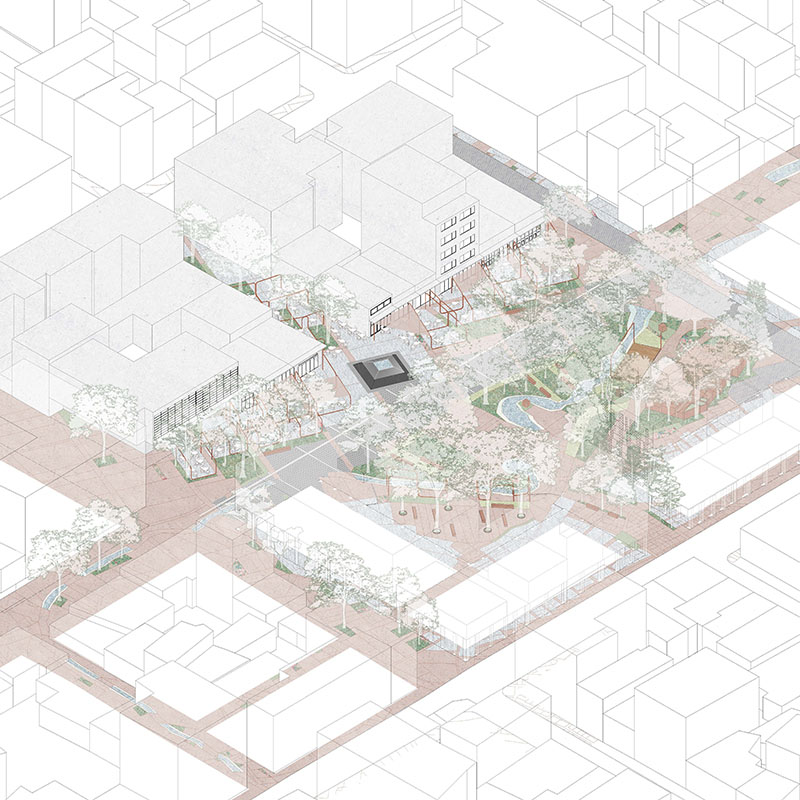
The following thesis focuses on the landscape regeneration of Central Square and Agora Square in the city of Karditsa, aiming to create a resilient and sustainable public space that reconnects residents and visitors with the natural environment and the city’s historical identity. The proposal arose in response to the flooding that has affected the area in recent years, combined with the fragmentary interventions observed in the urban center, the high percentages of hard, impermeable surfaces, and the intense heat stress during the summer months.
The design approach draws morphological and conceptual elements from the rural landscape of the Thessalian plain, transferring its imprint into the urban fabric. The agricultural plots are transformed into green islands, pathways, and rest areas, while the river is converted into a linear bioswale with rain gardens that collect and manage stormwater. This water route begins at Agora Square, passes through Central Square, and ends at Pausilipo, the city’s park, forming a network of natural water management within the public space.
At the same time, the highlighting of historic buildings along the route activates the collective memory and identity of Karditsa, transforming the public space as a whole into a realm of experience, strolls, and collective coexistence.
Keywords: urban center, public squares, agricultural landscape, stormwater management, linear rain garden