Supervisor:
2026
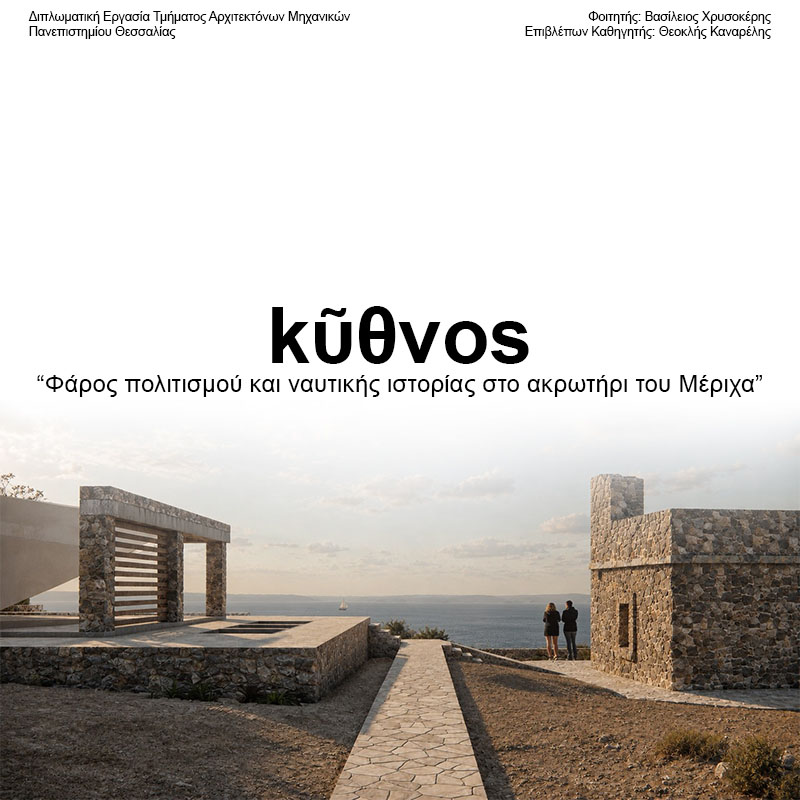
The thesis titled “Kythnos: A Landmark of Culture and Maritime History at the Cape of Merichas” examines the lighthouse not merely as a technical aid to navigation, but as a carrier of memory, history and cultural identity. The research begins with the observation that lighthouses, especially traditional stone ones, are powerful landmarks within coastal landscapes. They combine technical precision, simple geometry, durable materials and strong symbolic value. Although they were originally created for practical maritime purposes, they are also monuments of technological progress, naval history and human presence in remote coastal environments.
The project focuses on Kythnos and, more specifically, on the cape of Merichas, located at the entrance of the island’s main port. This site is significant because it condenses several meanings: arrival, transition from sea to land, observation, orientation and memory. On the cape stands the ruin of an old stone lighthouse, which has lost much of its original form and survives today only in fragments. The thesis does not treat this ruined condition simply as a problem that must be repaired. Instead, it interprets the ruin as a valuable trace of time, decay and historical continuity.
The central idea of the proposal is that the lighthouse should not be restored merely as an isolated monument, nor should it necessarily return to its original operational role. Rather, it can become the core of a wider public complex: a multifunctional centre of culture and maritime history. The project responds to three main issues identified through the research: the abandonment of the lighthouse, the need for cultural infrastructure on the island, and the absence of a dedicated space for presenting the maritime history of Kythnos and the Cyclades.
The architectural approach is structured around three principles: respect for the ruin, integration into the rocky landscape and the reinterpretation of Cycladic settlement logic in a contemporary cultural facility. Instead of creating one large and imposing building, the complex is developed as a composition of smaller volumes, paths, courtyards, pauses and semi-open spaces that follow the morphology of the cape. The programme includes a maritime history museum, cultural event spaces, an open amphitheatre, outdoor and semi-outdoor circulation areas, administration and technical facilities. Stone becomes the main material linking the new intervention with the landscape and the lighthouse ruin, while concrete and metal are introduced as contemporary construction elements with both functional and symbolic roles.
Lighting is a crucial part of the proposal, as it directly connects the project to the idea of the lighthouse. The aim is not simply to illuminate a building, but to design a lighting system that turns the complex into a contemporary point of reference. The proposal combines the possibility of an official navigational light, if approved by the relevant authorities, with architectural lighting that highlights the stone, the ruin, the routes and the night-time presence of the cape. In this way, the old lighthouse returns to the landscape not as a fully reconstructed object, but as a living memory. The new cultural and maritime history centre does not only illuminate the sea; it illuminates the history of Kythnos, the need for public space and the possibility of a contemporary architecture born from the landscape itself.
Keywords: lighthouse, culture, maritime, history, cape