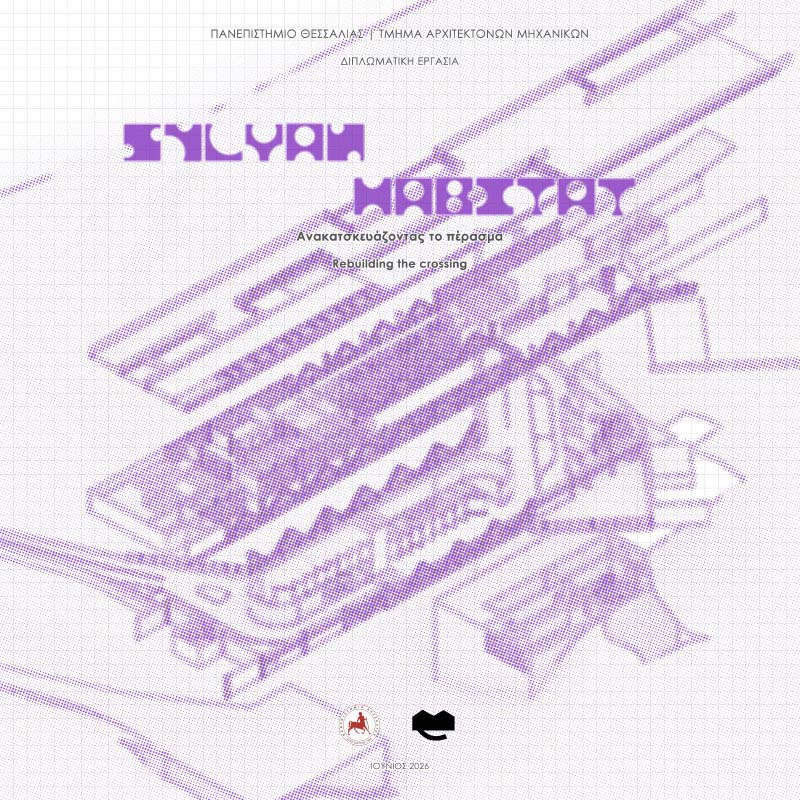
The starting point of this diploma thesis was the investigation of the impacts caused by Storm Daniel in Eastern Pelion. Through the exploration of the area and the observation of the changes the landscape underwent, the question emerged of how an architectural proposal could be designed to highlight the new morphology of the landscape rather than conceal it.
The research began with a series of site visits and field recordings in Eastern Pelion, focusing particularly on the Kalokairinou stream and the bridge of the Zagora – Pouri provincial road that crosses it, which had suffered severe damage during the floods. At the same time, the area’s flora, fauna, agricultural activities, and the ways in which locals and visitors interact with the Pelion landscape throughout the year were examined.
Through this process, the proposal on an inhabitable bridge was developed. Beyond serving as a simple crossing structure, the bridge is conceived as a multifunctional place for staying, observing and inhabiting. It connects with the area’s hiking trails, integrates into the natural environment through its planted roof and accommodates different forms of temporary dwelling, viewing points and facilities that serve both visitors and locals.
The main objective of the proposal is to create a place where people are not isolated from the natural environment but are instead encouraged to experience it, understand it and coexist with it. In this way, the bridge functions as a medium of connection between landscape, habitation and collective experience.
Key words: Pelion, biotope, storm "Daniel", reconstruction, habitable bridge