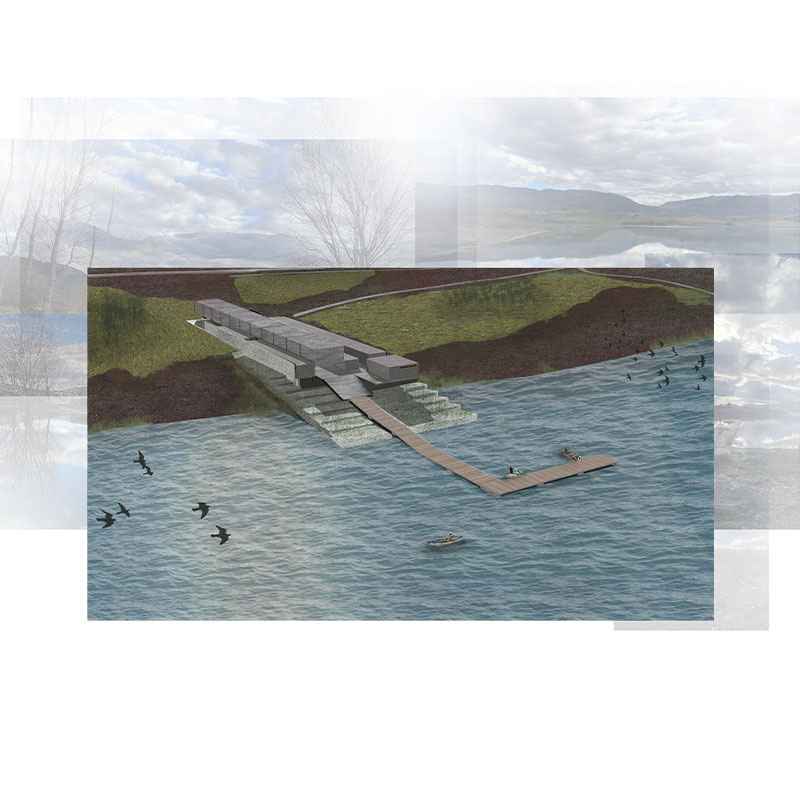
This diploma thesis investigates the concept of variability as the capacity to adapt to and coexist with environmental changes, rather than resist them. Starting from the observation of certain natural phenomena, and primarily the fluctuation of water levels, the study explores a version of architecture that embraces change and transforms along with it. The artificial Lake Polyfytos in the Kozani regional unit was selected as the study area, a wetland with rich biodiversity and significant fishing activity. Fluctuations in the lake’s water level reach up to 15 meters annually, creating striking visual and environmental transformations.
Despite its abundance of freshwater fish and its tourism potential, the area lacks organized fish-trading infrastructure. For this reason, the proposal concerns the creation of a fish market at the floating port of Servia. The building is positioned directly above the lake’s maximum operating water level (291 m) and is designed to dynamically adapt to water level changes through the addition of a ramp and a floating platform. The functional program is variable and develops through three phases during the day: fish trading and auctioning during the early morning hours, followed by cleaning and processing activities, and operation as an open market for local products, a gastronomic space, and a venue for social events from the afternoon until the evening. Through this multifunctionality, the continuous use of the space is ensured.
From a construction perspective, the proposal employs gabion bricks to create retaining walls and terraces for soil stabilization. An elevated steel structure frees the main space from the constraints imposed by the required equipment and emphasizes the functional program, while the use of natural and local materials helps the building harmonize with the landscape.
This thesis proposes an architecture that does not impose itself on the environment, but instead turns variability into an advantage and creates a new center of economic, social, and cultural life for the wider Lake Polyfytos region.
Keywords: variability, water level, adaptation, lake, fishing, fish market