Supervisor:
2026
This diploma thesis investigates the recomposition and reappropriation of the Mornos Plain, an agricultural and deltaic landscape in Phocis, which today exists in an interme-diate condition between productive memory, ecological value and abandonment. The area, once an intensively cultivated plain, has undergone significant spatial, hydrological and social transformations. The construction of the embankments, the operation of the Mornos Dam and the incomplete land consolidation project altered the relationship be-tween the landscape, water, cultivation and the everyday life of its inhabitants. Through a historical and spatial reading of the plain, the thesis approaches the existing traces not as remnants of failure, but as starting points for design. The embankments, the land consolidation grid, the inactive irrigation systems, the wetland zones, the semi-ac-tive cultivations and the protected ecological identity of the area form a complex land-scape in suspension. The proposal seeks to transform this condition of suspension into a field of possibility, introducing new forms of production, collective use, environmental education and gentle wandering.
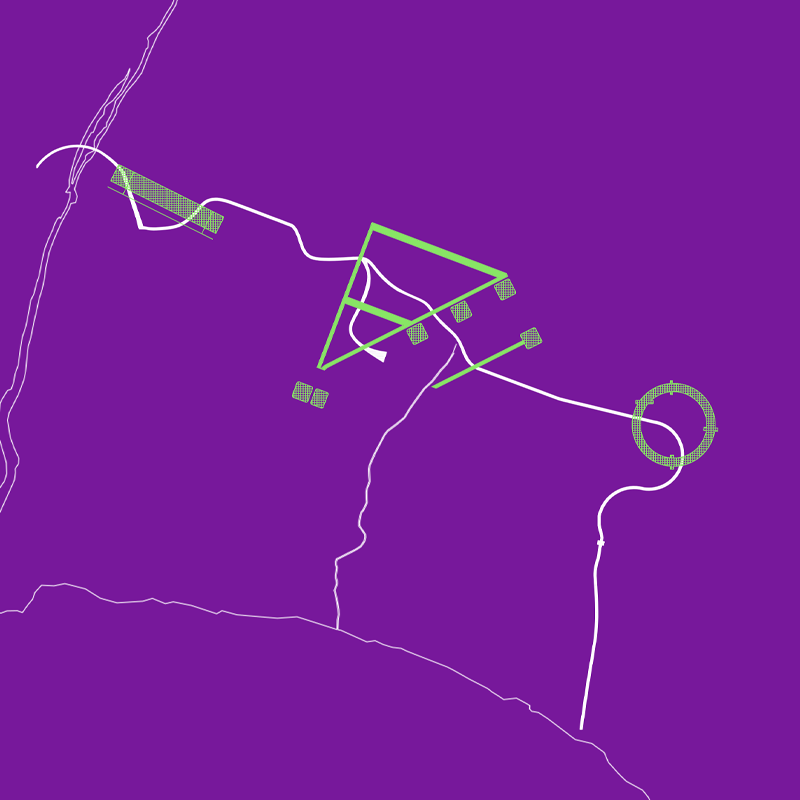
The central compositional tool is the route “deo”, an organic pedestrian and bicycle path that acts as a linear connector between the three main nodes of the proposal. The route does not simply organise movement, but produces relationships between people, land, water and the ecosystem. Along its length, it transforms into a bridge, an elevated pas-sage, a resting point, an open-air amphitheatre and a birdwatching tower, turning wan-dering into an embodied experience of the landscape.
The first intervention, the Productive Field and Centre for Collective Habitation, reintro-duces cultivation as a collective practice of care, dwelling and agritourism. The second, the Common Ground of Environmental Knowledge and Community, forms a core of in-formation, cooperative organisation and natural building around a new water condition. The third, the Experimental Field and Ring of Agricultural Research and Experimenta-tion, introduces a space for testing, education and research around soil, water and new agroecological practices.
Overall, the thesis proposes a new common productive landscape, where architecture is not imposed upon the land, but operates as a mechanism of care, activation and collec-tive reconnection. The Mornos Plain is reinterpreted as a place of knowledge, cultiva-tion, ecology, community and wandering.
5 Keywords:Reappropriation of the countryside, Productive reactivation, Landscape in suspension Collective autonomy Ecological restoration