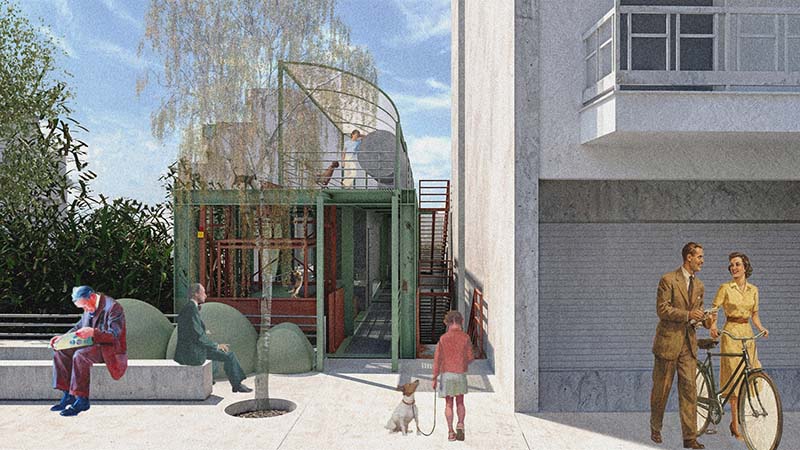
This diploma thesis explores the activation of urban voids through processes of transforming material residues, proposing a redefinition of the relationship between human beings, nature, and the city. Through a process-based methodology, the relationship between body and matter is examined, through which compost emerges as both medium and mode of application. The research follows a trajectory from the familiar to the collective, from the private to the public, from the small scale of the room to the scale of the neighborhood and the urban void. In the first part, the room is defined as an initial field of investigation, where an attempt is made to initiate a dialogue and to search for a shared language and conceptual framework. This stage functions as a preparatory phase, during which the tools of thought and the terms with which we subsequently operate are produced. In the second part, the investigation shifts from the interior field of the room to the urban landscape of Athens. Specifically, it focuses on an empty lot in Neapoli, Exarchia, at the intersection of Laskareos and Hippokratous streets, which is approached as a “third landscape” according to the formulation of Gilles Clément - that is, as a residual space. The analysis of existing materials, the ecosystem, the temporal layers of the site, and the residues of the neighborhood leads to the selection of compost as a process for activating the ground. Operating as a machine both literally and conceptually, it connects the vacant lot with the neighborhood, attempting to redefine the relationship between human and nature within the urban fabric.
Keywords: room, the third landscape, the third room, matter, compost, engagement