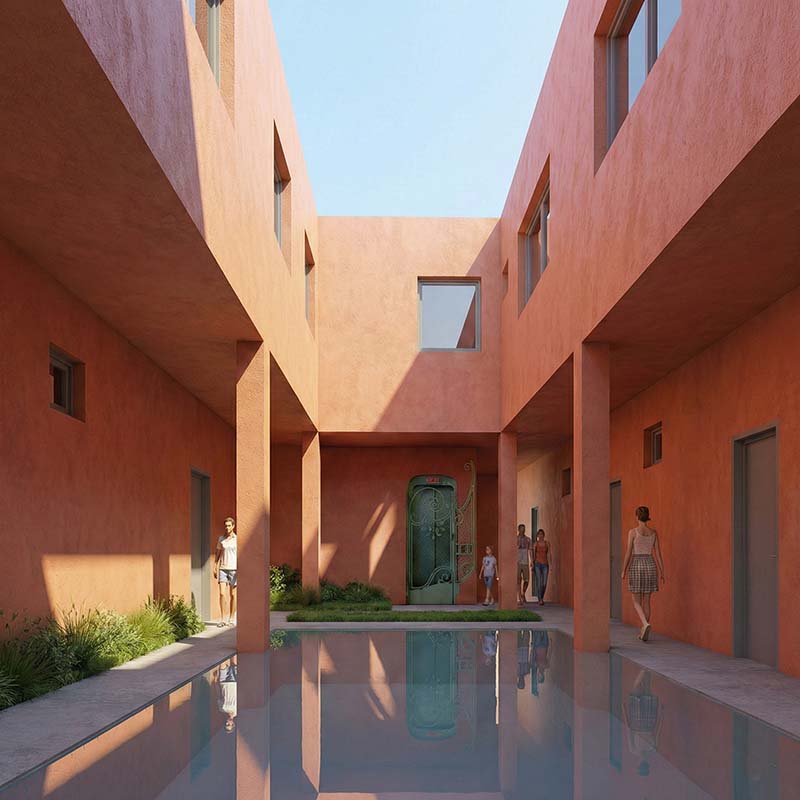
The present diploma thesis addresses the redesign of the living experience in Gerakas, Attica, proposing a mixed-use building that responds to both the housing and social needs of the suburb. The aim is to create a sustainable living model, where natural light and collectivity function as primary compositional tools.
The building program is organized vertically with a clear functional separation. The ground and first floors host uses that serve the immediate needs of residents and interact with the urban fabric: a preschool center to support working parents, a supermarket, and a gym with a café that enter into a dialogue with the neighboring Sports Center. The upper floors (2nd, 3rd) accommodate the residences. The central composition idea is the introduction of a system of atria that penetrates the building volume. The central atrium functions as a circulation core and entrance to the apartments, while smaller, private atria-one for each residence-ensure the necessary privacy and provide cross-ventilation and natural lighting for each unit individually.
The architectural composition is scientifically documented through an energy study (TEE KENAK) and extensive bioclimatic analysis using Climate Studio software. Morphologically, the proposal is characterized by the use of pressed cement screed in an earthy terra cotta shade, a choice that adds materiality and harmoniously integrates the building volume into the environment.
Keywords: Mixed-use, atrium, bioclimatic design, natural lighting, urban living