Supervisor:
2026
The aim of the present thesis is the study and application of the practice of availability-based design, proposing the creation of a laboratory of study and growth of seeds at the Agricultural School of Volos through the use of local, reclaimed building components.
The thesis is structured in two parts, a theoretical and a practical one. More specifically, the first part initially draws upon the research project “The Materials’ Biography in Construction through Examples of Linear, Recycle, Circular and Bio-Based Design Logic”, carried out in collaboration with my fellow student Dimitris Zaras. A concise overview is provided of the environmental crisis, the share of responsibility attributed to the construction sector, as well as of the circular economy and its associated strategies, as a response to this issue. Subsequently, participation in the theoretical workshop Circu/ability (BIP) [Antwerp, July 2023] served as a foundation for mapping the process followed in the practice of availability-based design in European countries such as Belgium and the Netherlands. In addition, the corresponding process as implemented within the framework of the Layers of Permanence (LoP) workshop [Volos, April 2024] is presented, based on the experience gained through participation in its support team.
The second part concerns the application of this design practice in the city of Volos. More specifically, selected building components reclaimed within the framework of the LoP were studied through observation, measurements and experimentation at 1:1 and 1:20 scales. Subsequently, based on the identified potentials and weaknesses of these elements, as well as following a meeting and proposal by Eythymia Levizou—Associate Professor at the Agricultural School of Volos—the design of a small passive greenhouse was decided, in order to cover the needs of the school’s relevant courses. This was followed by a design exploration phase, during which principles and strategies of the circular economy were applied, such as design for disassembly, layering, and the R-strategies, aiming at the most effective possible design outcome.
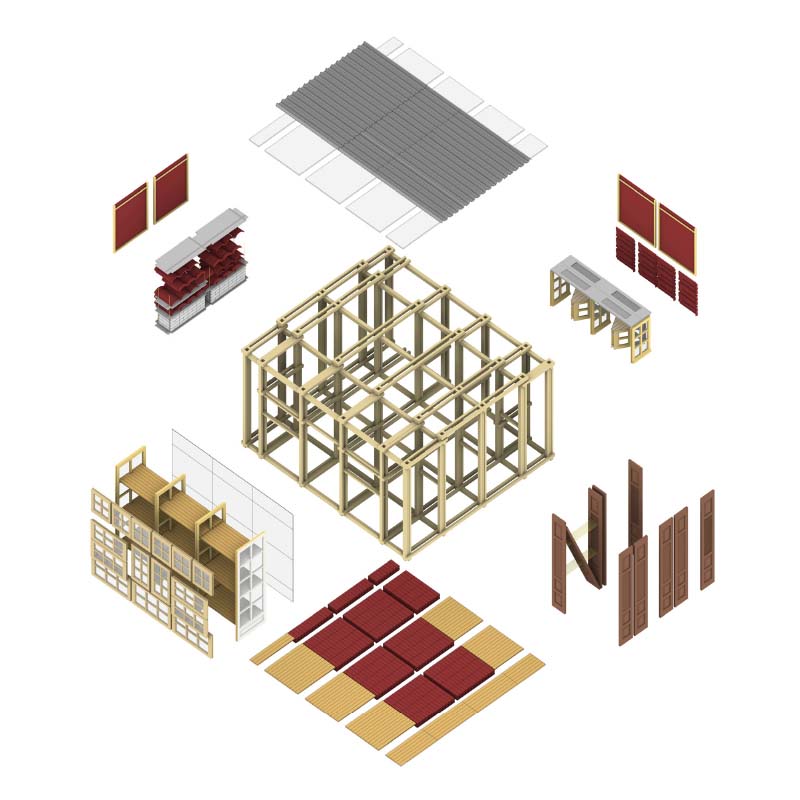
The final proposal concerns a rectangular, semi-open structure, with a wooden load-bearing system and predominantly reclaimed infill components, along the perimeter of which four distinct zones of use are organized. The objective is the creation of a central circulation space, enabling the internal use of the structure as laboratory of study and growth of seeds by members of the academic community (introverted character). At the same time, the structure allows for use from its exterior side as well, serving both academic purposes and outreach activities aimed at raising public awareness, through the distribution of produced seedlings, the organization of workshops, the presentation of related research, and exhibitions highlighting the importance of seeds. Finally, provision has been made for the future expansion of the structure in order to address potential emerging needs.
Keywords: Circular Economy, Reuse, Design for Disassembly, Reclaimed Building Components, Pavilion-Scale Structure