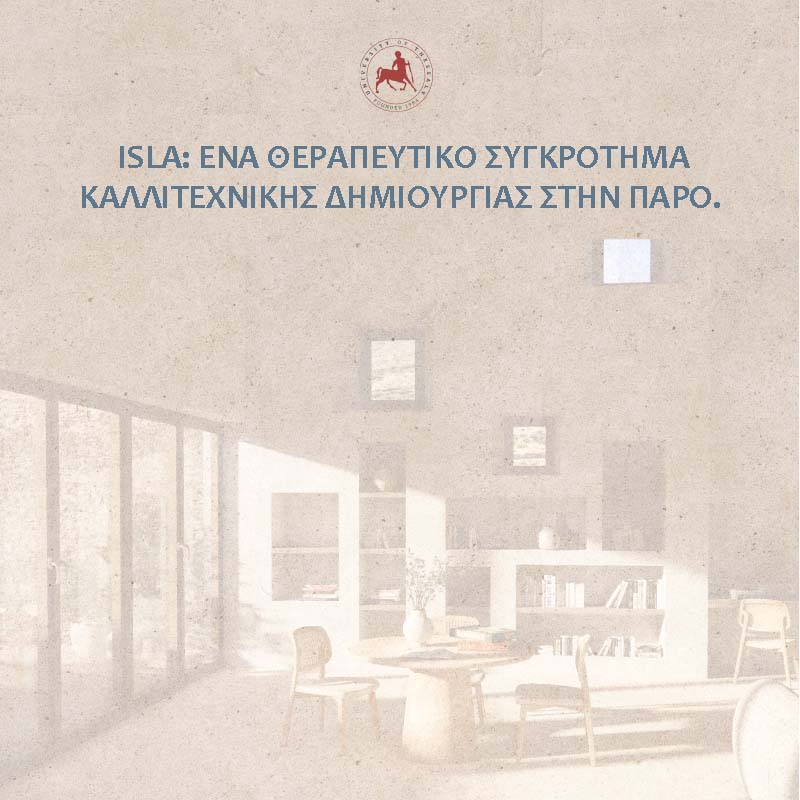
This thesis explores the role of architecture as a means of therapy, through a therapeutic complex of artistic creation on the island of Paros, which is aimed at people experiencing mild to moderate forms of psychosocial stress, such as chronic stress, depression, transitional life phases, and mild addictive or compulsive behaviors.
The treatment is approached as a spatial, social, and experiential process, without the need for medical practice, and is achieved by following the therapeutic community model, which is based on coexistence, collectivity, and participation. The complex, therefore, which is dedicated to caring for both people and the place, which in recent years has been affected by increased tourist and construction activity, with serious consequences for the natural environment, approaches the island not only as a geographical condition, but also as a symbolic framework of isolation and reconnection. At the same time, both contact with the natural environment and artistic creation through the complex's workshops contribute to the healing process.
The architectural composition is organized into low-scale, fragmented volumes, incorporating elements of traditional Cycladic architecture, as well as the landscape and climate of the area, such as the meltemia winds and natural lighting. The complex supports different degrees of privacy, as the presence of the canopy conceptually divides it into two degrees of privacy.
Consequently, the proposal attempts to highlight the role of architecture as a tool for care, by proposing a non-clinical environment that promotes mental relaxation, reconnection with the place, and the collective experience of habitation, while at the same time proposing an alternative model of architectural intervention in Paros.
Keywords: community, connection with nature, meltemia, habitation, fragmentation of volumes