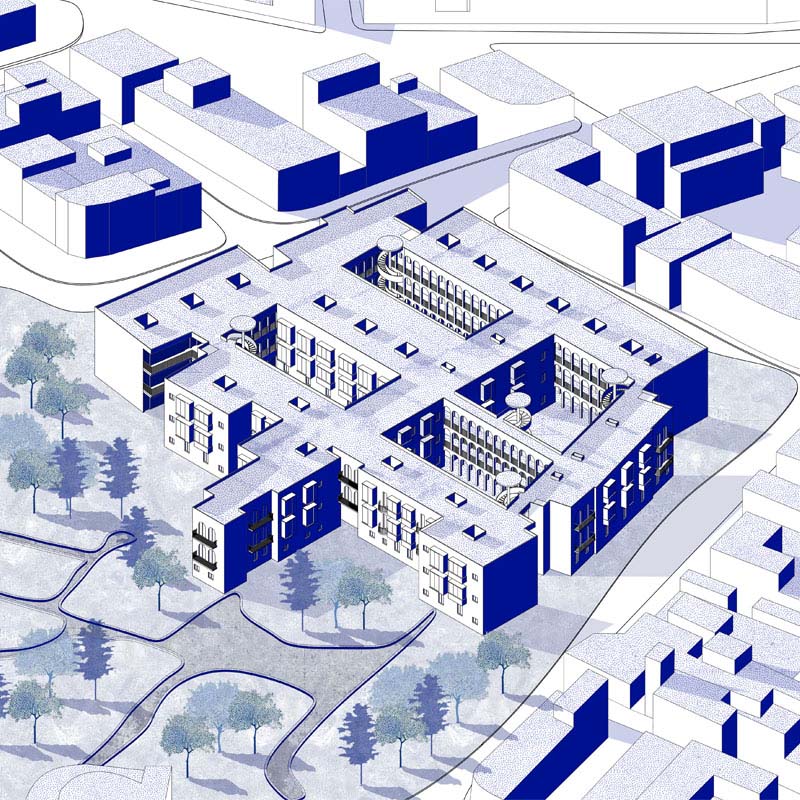
This diploma project explores the design of a residential complex in Valletta, Malta, investigating how contemporary housing can reinterpret the fundamental principles of traditional Maltese architecture. Rather than reproducing historical forms, the project focuses on translating the spatial logic of the local architectural tradition into a contemporary urban context, shaped by high density, Mediterranean climate conditions, and the lack of public green spaces.
The proposal is structured around a system of internal courtyards and atria that serve as spatial and social cores, ensuring natural light, ventilation, and gradual transitions between public, semi-public, and private spaces. Emphasis is placed on the reinterpretation of erkers (gallarija) as contemporary living filters that mediate the relationship between the dwelling and the street, as well as on the use of circular staircases conceived as active architectural elements that organize movement and enhance spatial experience.
Beyond the architectural object, the project integrates a landscape strategy, introducing a new park and green areas within a densely built neighborhood that lacks such infrastructure. Landscape is treated as an integral component of housing, contributing to social interaction, environmental quality, and microclimatic improvement.
Overall, the project proposes a collective, context-sensitive model of housing that seeks to bridge tradition and contemporary living, contributing to the broader discourse on sustainable and socially responsive housing in the Mediterranean city.
Key words: Malta, mediterranean housing, collective living, courtyard architecture, landscape integration