Canter argues that the concept of the therapeutic environment carries a dual meaning: on the one hand, it refers to a space intentionally designed for therapeutic purposes, while on the other, it describes a space that has a healing effect without this being its original intention.
Foucault describes how, during the Middle Ages, the “mad” were crowded onto ships with unknown destinations, illustrating how mental disorder became synonymous with confinement, social marginalization, illness, deprivation, and mistreatment. He reveals how deeply a society founded on rationality is unsettled by the existence of the non-rational.
In a world marked by fast-paced living, increasing socio-economic and political challenges, and unprecedented health and social phenomena such as the COVID-19 pandemic, discussions around mental health have been brought to the forefront, along with questions regarding how architecture is expected to respond to these challenges. The concept of self-care is increasingly adopted during periods of social and economic instability. While there is a noticeable rise in the number of individuals turning to psychotherapy and psychiatric care, long-term stabilized psychiatric patients often rely on small and frequently insufficient programs, offering limited opportunities for socialization, reintegration, empowerment, and the recovery of social skills. At the same time, mental health stigma continues to persist, despite significant efforts toward its elimination.
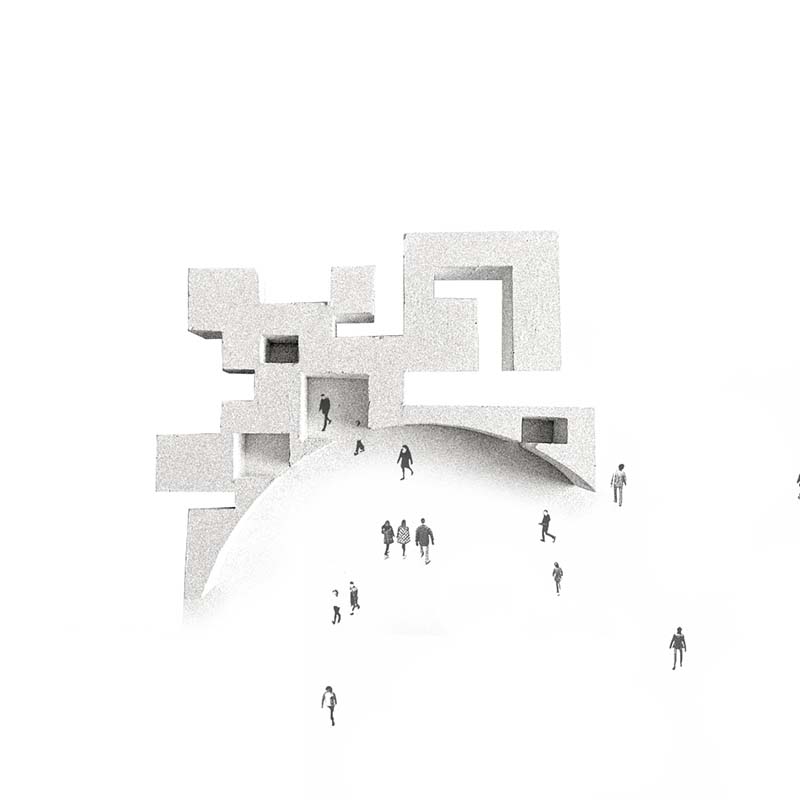
This diploma thesis explores spaces for the healing of the psyche and the promotion of mental health through the proposal of a scenario for a Day Care Center for psychosocial reintegration, located at the old quarry in Goritsa, Volos. Through spatial and conceptual binaries such as mass–void, interior–exterior, light–shadow, private–public, and natural versus built landscape, the study seeks to examine and redefine mental health-related spaces free from asylum-like characteristics. The individual is placed at the center, in relation to others, the natural and built environment, at the threshold between city, hill, and sea.
key words : Healing, residual landscape , void–mass, porous, contrasting landscapes