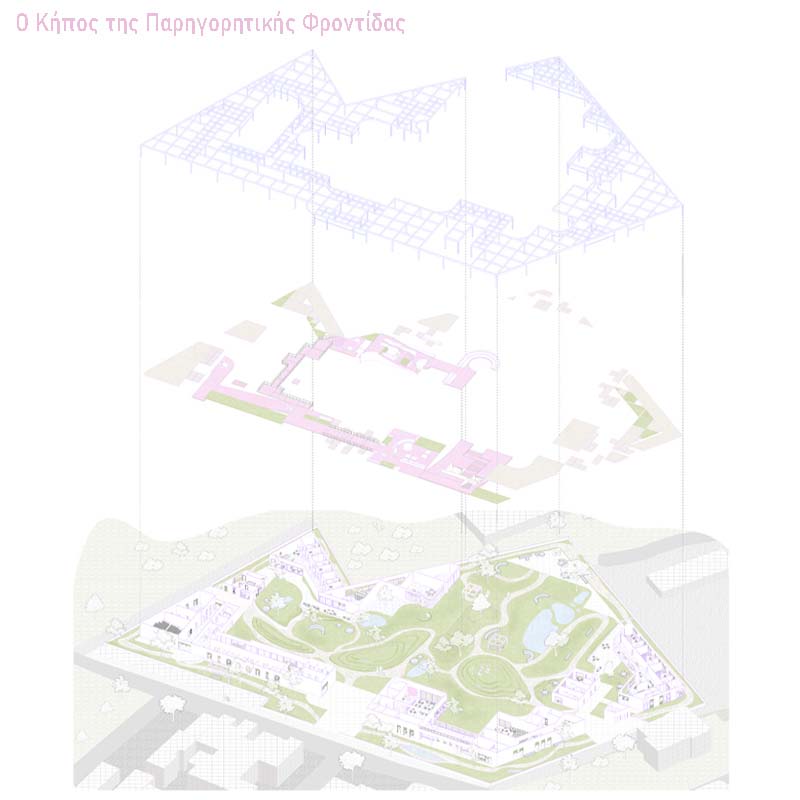
This thesis explores the architectural design of a palliative care unit organized around an open, community-accessible garden. The garden is not treated as a mere outdoor space but as an active element of care and social interaction, capable of connecting the building with the city and integrating everyday life into the therapeutic environment.
The proposal seeks to redefine the concept of palliative care, moving away from its traditional perception as isolated and marginalized. Instead, care is approached as part of a continuous journey that accompanies individuals through different stages of life, emphasizing the quality of daily life, emotional support, and the preservation of dignity.
The study is framed within the context of the limited provision of palliative care in Greece, where the lack of organized structures and minimal institutional integration often result in hospital-centered patient management. Through architectural design, the work critiques the tendency of modern healthcare facilities to operate as closed, detached systems, disconnected from the urban fabric and collective experience of the city. Here, care is reinterpreted as a spatial and social condition, capable of coexisting with public space, fostering visibility, interaction, and gentle social engagement, without compromising the need for privacy, calm, and protection for patients and their families.
Particular attention is given to the relationship between the building and the landscape, the management of transitions between public and private realms, and the creation of spaces that support different everyday activities: staying, caring, waiting, reflection, and gathering. Through layered spatial experiences, the building functions as an intermediary place between the city and the individual, moving away from a strictly institutional character and adopting qualities that evoke habitation and lived experience.
Keywords: Publicspace, Treatment, Quality of life, Urban Green Space, Social Integration