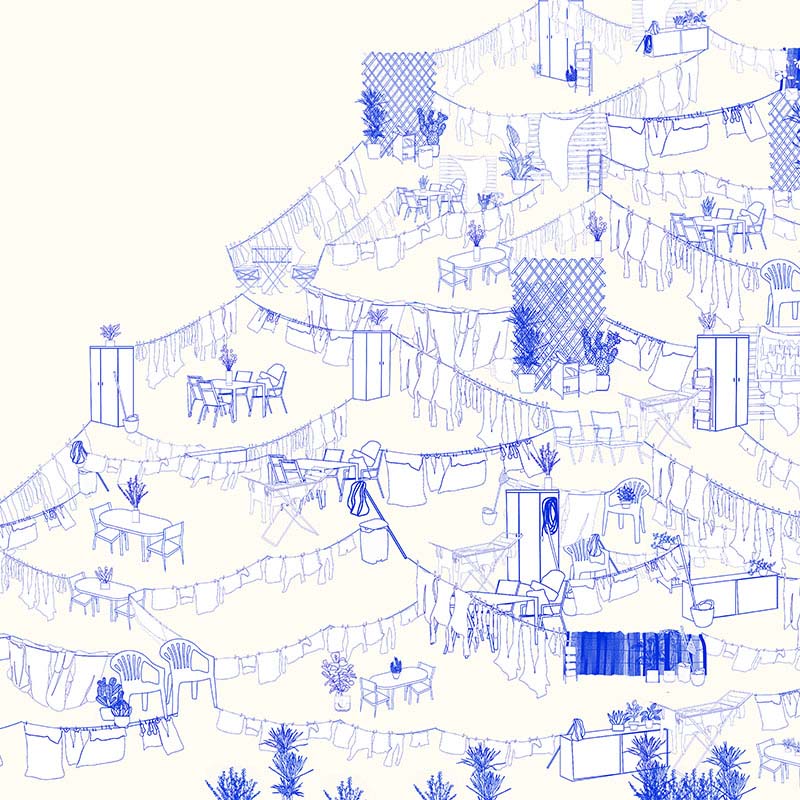
This thesis focuses on the laundry line, which is analyzed as a primary nonverbal code of communication and a dynamic tool for social negotiation. Laundry is not simply a utilitarian drying process, but a public confession that reveals information about an individual's identity, age, economic class, and family status, functioning as an extension of personality in space. Despite its importance, contemporary urban perception and modernism began to perceive it as "aesthetic pollution," leading to bans that impose a sterile image of public space and erase the traces of the daily survival of the working classes. This trend, expressed institutionally through the 1996 police order and the strict ban in the contemporary project "The Ellinikon," threatens to transform the city into Rem Koolhaas' "Generic City." This is a place without any particular characteristics, where homogeneity erases human presence and memory, transforming urban space into a "transparent logo" without depth.
In the scenario examined by the study, prolonged water shortages in Attica and pressure from large construction projects, such as Elliniko, which requires millions of cubic meters of water annually, are turning water into a high-cost resource, causing violent social restructuring. This situation leads to extreme overcrowding, where apartments such as E.10.1 in Ellinikon are forced to accommodate up to 13 people, completely overturning the original architectural planning. In this context, the living room loses its identity as a place of relaxation, as it simultaneously absorbs the needs for sleeping and drying clothes, transforming into a purely functional space.
In response, the architectural proposal treats the clothesline as a space rather than simply a household item, creating a system of metal components that allows the user to configure the framework of their personal space. This system consists of five cylindrical types of metal rods (A1, A2, B, C1, C2), which have perforations that serve a dual purpose: they function either to develop the structure in height or as passages through which the clothesline passes. Through five different types of assembly for single and double beds, the clothesline action offers the feeling of a private bedroom space, as the hanging fabrics obstruct visibility while allowing light and air to flow continuously within the structures.
Façade , identity , fabrics , water shortage