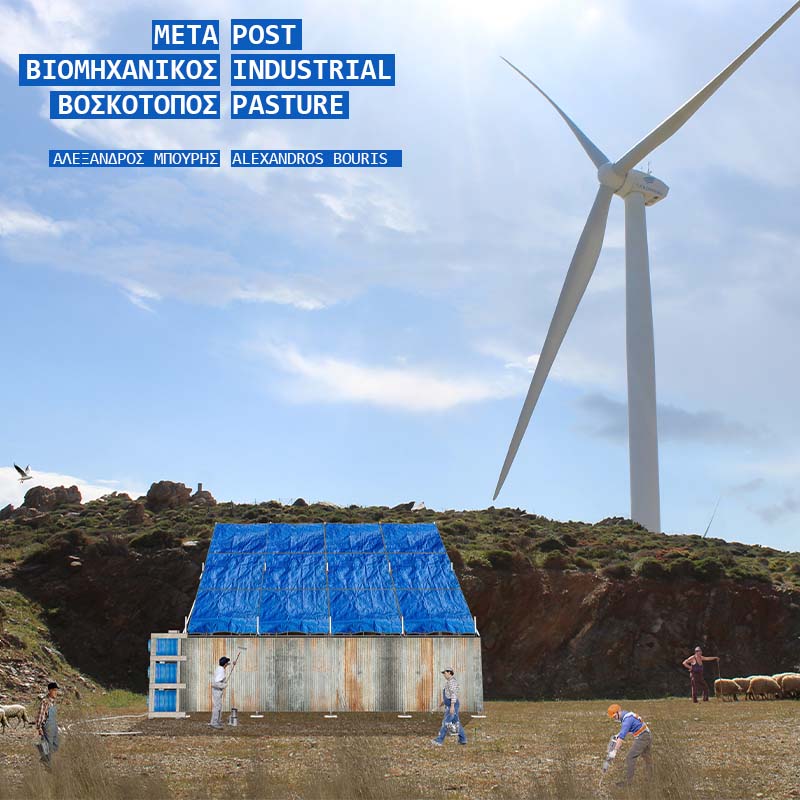
The diploma thesis deals with the regeneration of a former wind farm within the agricultural landscape of Kafireas, also known as Cavo D’oro, in South Evia, Greece.
Specifically, it is a mountainous terrain where, after years of abandonment of inactive turbines, the authorities removed the industrial waste of the wind machines and carried out earthworks, leaving behind filled-in spaces of inert materials. By re-thinking the narratives and tools of design, the proposal seeks to reverse this deeply negative ecological footprint, aiming at the reinhabitation of the landscape by humans and animals, as well as the healing of nature, creating a Post-Industrial Pasture.
The design approach is conceived as a process in constant transformation; it does not aim at a final, permanent outcome, but rather at a dynamic relation with time, nature, and decay. It does not attempt to document a construction, but a strategy of landscape restoration through embodied experimentations, along with an effort of coexistence (symbiosis) with technological infrastructures.
Diploma’s interpretation of The Companion Species Manifesto (Donna Haraway) calls us to examine machines as potential companions within our environment. Just as humans coexist with other species and shape relations of mutual influence, the presence of machines in the landscape may be considered as a form of companionship that shapes the dynamics of the ecosystem. Not, within the framework of a “corporate beautification,” but as a practice of care and critical reintegration of machines into the collective ecological history.
Humans, animals, and machines share the same ground, co-shaping Kafireas together. These relations are neither romantic nor idealized; they are complex, mutual, often conflictual, but they generate a fertile field for architectural “becoming”.
Finally, the result of this work attempts to remind us that architectural tools can function not only as a means of building in new ways, but also as an opening to new, unpredictable forms of life.