Supervisors:
2025
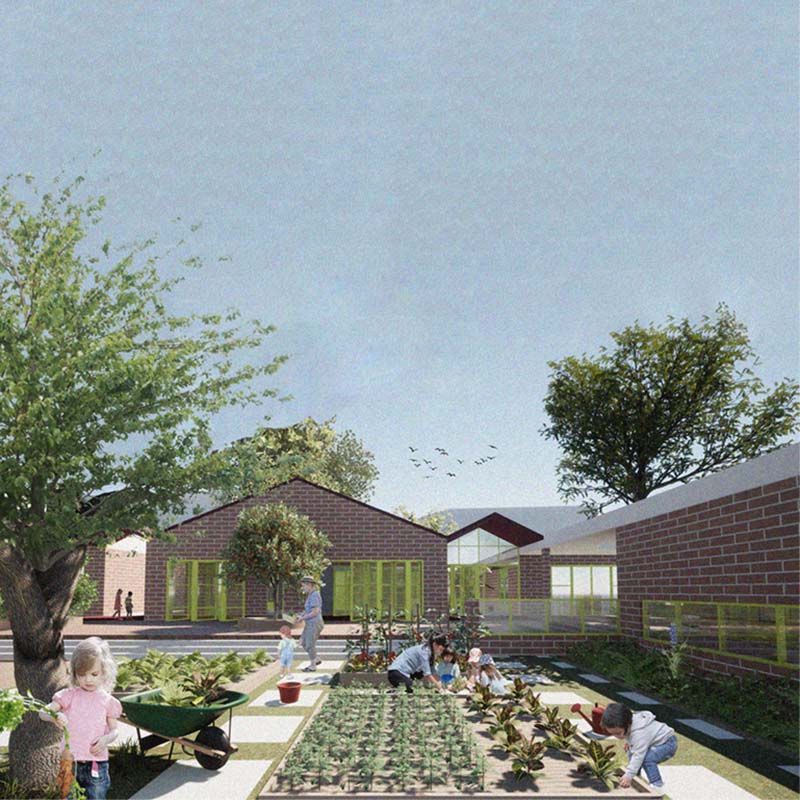
This study examines how a school garden can function as a learning and cultural tool in preschool education. It concerns the design of a school unit that bases its educational identity on an ecological, holistic, and experiential framework. Instead of the conventional model of a schoolyard with minimal or no greenery, it proposes the creation of a multi-themed garden. Such a garden—featuring tropical plants, flower beds, aromatic herbs, fruit trees, and above all a vegetable garden—offers children a wide range of experiences and stimuli, helping them to understand the cycle of life, to care, to observe, to explore, and to develop a deep ecological awareness. In this type of school environment, where architectural design and outdoor space complement each other, experiential and interdisciplinary learning is promoted. Children learn through action and experience, while at the same time developing cooperation, responsibility, and creativity—skills that are crucial for shaping their character.
The study focuses on the case of Xanthi. In fact, the choice of a vegetable garden acquires special significance in this city, as it resonates with the historical identity of the tobacco warehouses. The transition from tobacco cultivation to food cultivation symbolizes a profound shift in mindset: from commerce to self-sufficiency, from monoculture to knowledge and care. The school garden connects the school with society, serving as a microcosm that brings together learning, nature, and local history. At the same time, it contributes to the formation of the child’s identity, while offering a space for free expression, research, and experimentation.
Overall, the study demonstrates how a school unit can become a living, meaningful educational environment where children learn to care, to respect, and to actively participate in the world around them.
Keywords: thematic garden
preschool education
experiential learning
environmental awareness
local identity
school space