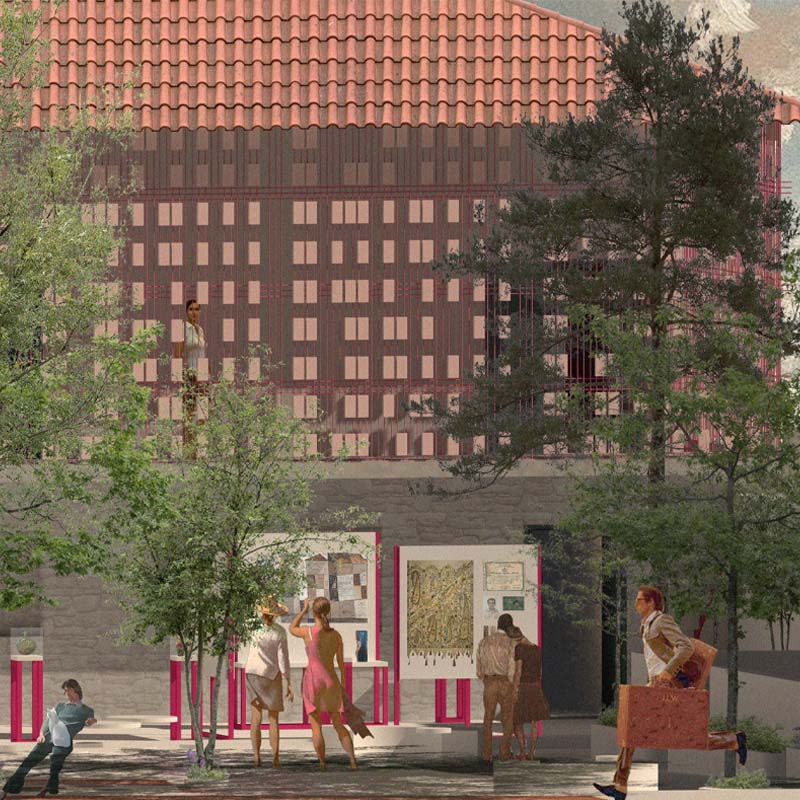
The thesis is inspired by the memory of the refugee housing in Nice and the need to redefine it not as abandoned shells, but as living fields of history, collectivity, and everyday life. From the historical background of 1922 and the settlement of refugees, the role of housing as the ultimate carrier of identity and memory emerged. At the same time, the relationship between memory and architecture was explored, not as a static representation, but as an experience activated in space.
The methodological course of the research began with the broader urban context—the city’s open spaces and common areas—and ended at building block 183, where impressions, mappings, and on-site observations revealed the spatial and social qualities of refugee and contemporary habitation. The traces of everyday life, the alterations of time, and the typological peculiarities formed the basis for an architectural proposal that attempts to preserve and highlight what already exists: the floors, the imprints of the walls, the symmetrical staircases and the balconies that were the main axes of movement and access to the houses and the open space as a place of collectivity. Through architectural interventions in the existing building stock and mild additions, the Museum of Refugee Heritage seeks to transform its own buildings into exhibits that tell their story.
The project does not treat the museum as a closed collection of objects, but as an open field of experience. A space that is not only aimed at its visitors, but mainly at the neighborhood and its residents, seeking to function as a hub of memory and activities. Thus, the proposal does not aspire to provide definitive answers; it attempts to show how architecture can engage with history, giving it new life in everyday life.