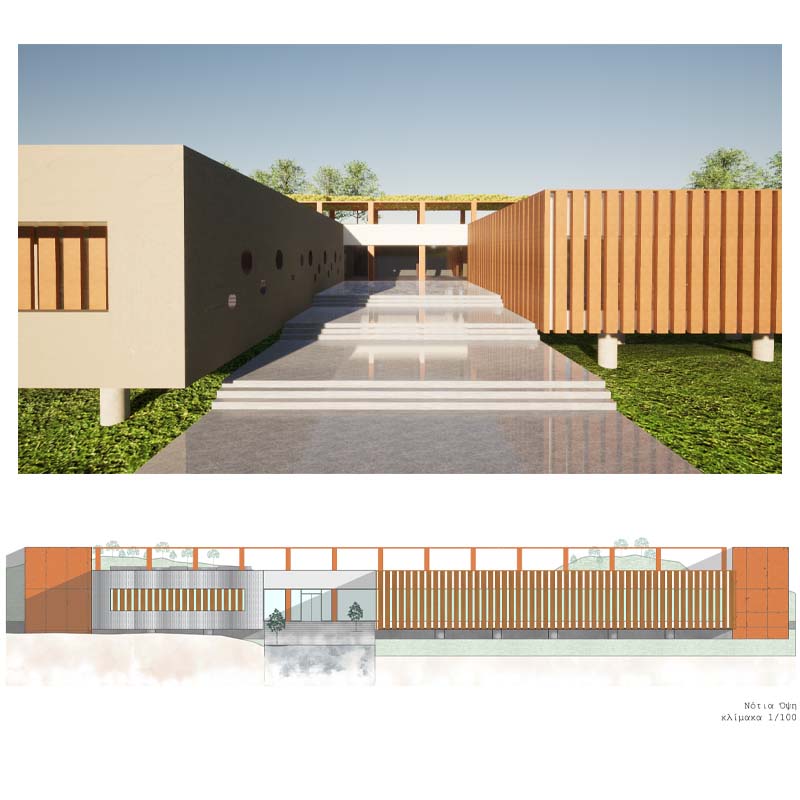
This thesis proposes the architectural design of a Research Centre for the History of Architecture, which seeks to incorporate contemporary practices of technological innovation in a building context dedicated to the study of the past. The main compositional proposal is concerned with the balance between historical memory and contemporary environmental performance through an architectural vocabulary that utilizes dynamic facades, passive systems and flexible spatial structures.
The functional identity of the Research Centre includes reading rooms, library, research laboratories, offices, amphitheatre spaces, and shared collaboration areas. The composition was based on the spatial layering of functions to ensure smooth flow, the possibility of quiet in the study spaces and at the same time meeting and sharing in the public cores.
The central element of the proposal is the energy strategy of the shell. The building incorporates a Dynamic Façade System, which functions as a 'smart' mediator between the external environment and the internal conditions and is organically integrated into the architectural discourse of the building, acting as a morphological and technological tool.
The choice of reinforced concrete as the main construction material was based on its load-bearing capacity, its thermal inertia and its inherent morphological ability to express robustness, permanence and clarity. Complementary, high strength and natural texture materials such as stone, wood and thermal insulating slabs are used to complement the historical content of the project.
The work is completed with the composition of a bioclimatically designed building, adapted to the environmental conditions of its location. Finally, the proposal aims to be an example of contemporary architectural research that respects the historical scientific knowledge it hosts, while meeting the sustainability imperatives of the future.