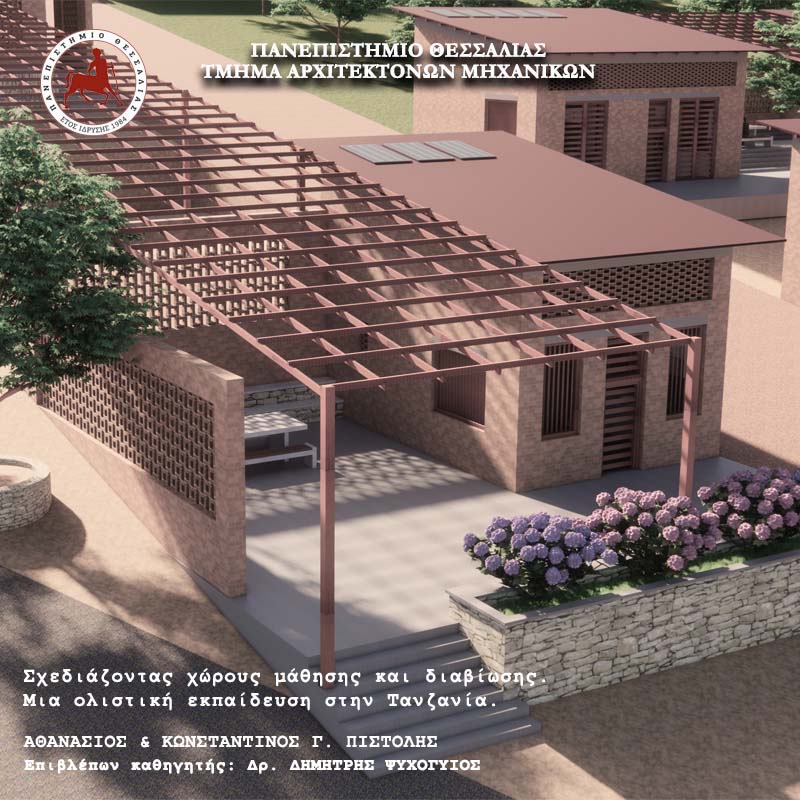
Our thesis deals with the creation of an educational complex with a community character, which includes, in addition to learning rooms, living spaces, thus supporting psychosocial empowerment and sustainable living. Through the Orthodox Mission of the Diocese of Bukoba, we were informed about the plot, the need and the importance of the existence of this complex in the area. It is a plot of 18.50 acres which is located in a privileged location, as it is a very short distance from the city center and at the same time, close to road axes that make it directly accessible from the surrounding areas.
The building complex is divided into three zones:
• Education, which consists of 4 rooms of 64 sq.m. as well as the administrative areas of the school.
• The second zone, which concerns community planning with activities outside of school, with the functions of the Amphitheater, the library and the Restaurant and
• The third zone, with the residence of students, in small units of 3-6 people in order to cultivate the concept of collectivity, with the main characteristic of privacy, but not introversion. It also includes 2 residences for teachers, strategically located in order to achieve a balance of privacy and discrete supervision.
The composition resulted from the mapping of the wider area, where access needs to infrastructure (hospital, public services, transport) were identified. The architectural proposal is based on the creation of an organized small-scale ensemble, integrated into the relief of the place, where learning and daily life are intertwined. The design utilizes:
• Local materials: rammed earth, wood, brick, light metal roofs and photovoltaics.
• Passive cooling, shading and natural lighting systems.
• Bioclimatic approach through orientation, planting and water collection (rainwater tanks).
The goal is a holistic educational experience that respects local culture and the human scale, building bridges between traditional lifestyles and modern pedagogical practices. Housing, here, does not function as a “necessary addition”, but as a structural component of the educational process, reinforcing self-sufficiency, care, cooperation and coexistence.