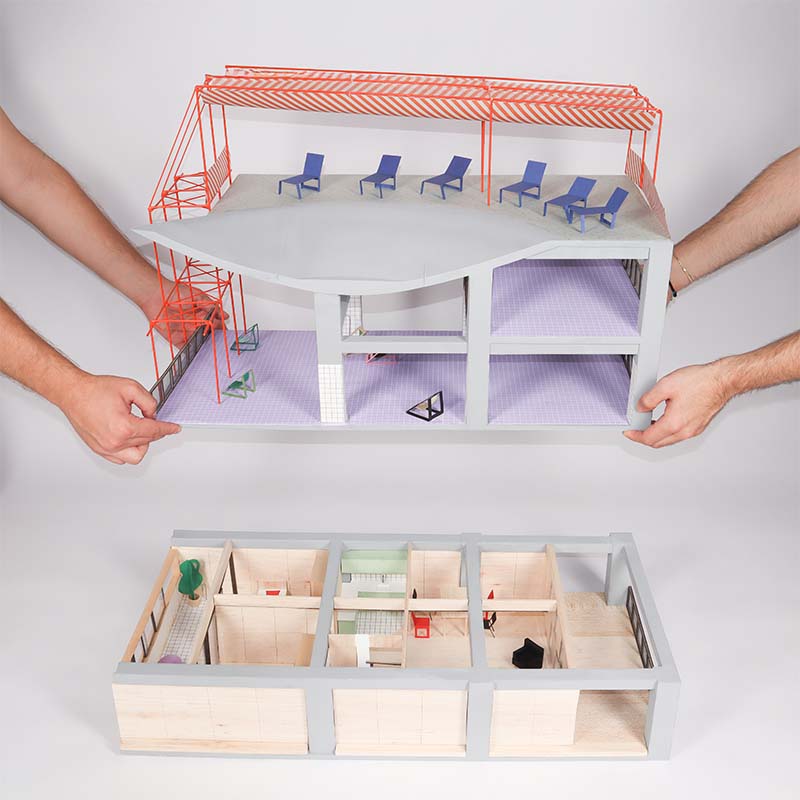
The questions of the possibility of coexistence for the different social subjects of the city and the direction in which the planning of Greek cities is heading, were the starting point of this thesis. Since the beginning of political thought and the creation of human societies, the question of the harmonious coexistence of different social groups has been fundamental in the evolution of the space designed by man. From Aristotle to Henri Lefebvre, the production of space has been a fundamental issue in the social contracts attached around the cohabitation of cities and urbanization processes in general. Having overcome economic, social and health crises, Greek cities today are called upon to redefine their planning and the way they redistribute their space to the various groups competing to reclaim it.
On the occasion of the massive evacuation of ministerial buildings in the center of Athens, due to the relocation of nine ministries to a new government park, the proposal of preserving the building stock and reusing it to create a new hypothetical scenario of a public housing policy is being made. Breaking away from the constraints of the real estate market and the unchecked adaptive reuse of the Athenian urban stock into hotels and short-term leasing apartments, an assemblage of trademark Greek experiences translated into spaces as well as a proposal for cooperative living and commoning at the center of the Greek capital, were the driving factors of this thesis. Following this reflective framework, “Social Assemblage” is an attempt to capture the social and architectural happenings in Athens today. Through the proposed assemblage of tourists and permanent residents, spaces of ritual consumption and collective care, a commentary and a proposal for inhabiting and sightseeing in the Athenian center is formulated.