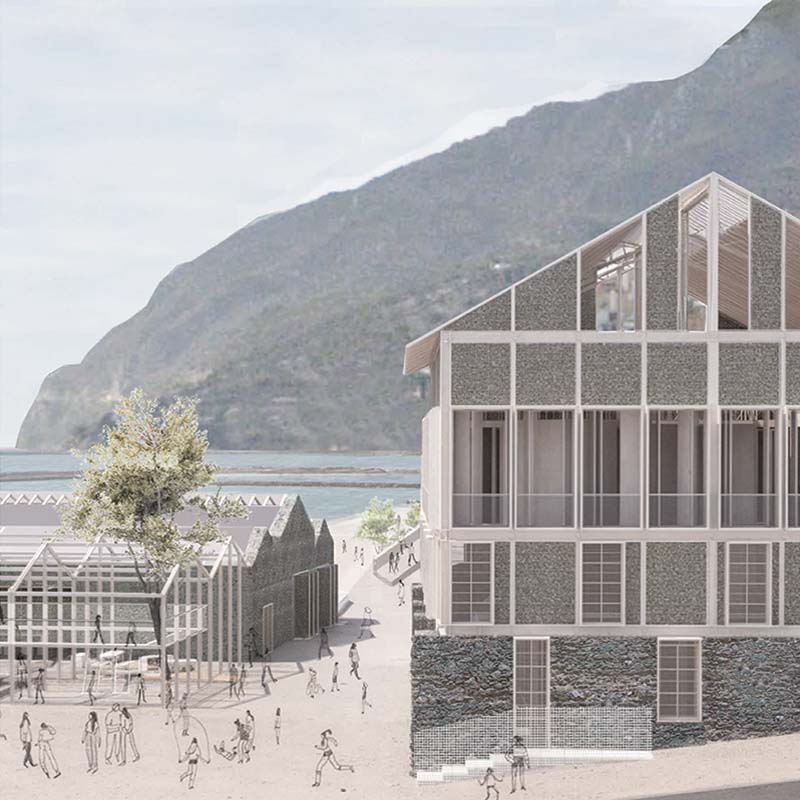
PROTONOTARIOS DAMASKINOS
Supervisor:
2025
How it all began.
T’ Mahalel is a combination of the word “mahallas”, meaning neighborhood, and the traditional Lesvian surname Michalelis. The initial T’ derives from the word “του” (meaning “of” in Greek) in the dialect of Plomari. The title carries within it a local, almost personal, story — evoking something familiar, a sense of everyday life that may be slowly fading, but is still worth preserving and keeping alive.
This diploma thesis is situated in Plomari, a traditional settlement on the island of Lesvos, known for its distinct identity and long-standing history. In the mid-20th century, Plomari was an important industrial hub for the island, with factories processing olive.
The gradual decline of industrial activity, combined with the socioeconomic changes of recent decades, led to the abandonment and decay of many of these buildings. Today, the remaining industrial shells stand as deserted ruins, slowly collapsing over time. Their presence within the settlement’s fabric remains uncertain — and in some cases, even dangerous — due to ongoing deterioration.
At the same time, Plomari, like many other areas in the Greek countryside, is experiencing a broader phenomenon of depopulation. Young people are leaving their hometown in search of better opportunities and more choices in urban centers. This population decline results in the loss of social vibrancy and the gradual erosion of the area’s collective memory.
The study of these buildings revealed the important social role they once played within the community. The adaptive reuse of these existing structures offers a means of preserving and restoring them — breathing new life into spaces that were once active parts of local life. At the same time, this process can contribute to reactivating the community’s collective memory and fostering the sustainable development of the settlement.
This thesis focuses on the study of this area, highlighting the social character and significance that these factories once held for the local community. Its central aim is to explore the potential for reusing the existing industrial shells, through strategies that promote their preservation, restoration, and reintegration into the contemporary life of Plomari. Through the activation of historical memory and the valorization of industrial heritage, the project aspires to bridge past and present — proposing ways to enhance the social character and collective identity of Plomari. These new social functions will inhabit spaces that were once vital components of the town’s everyday life.