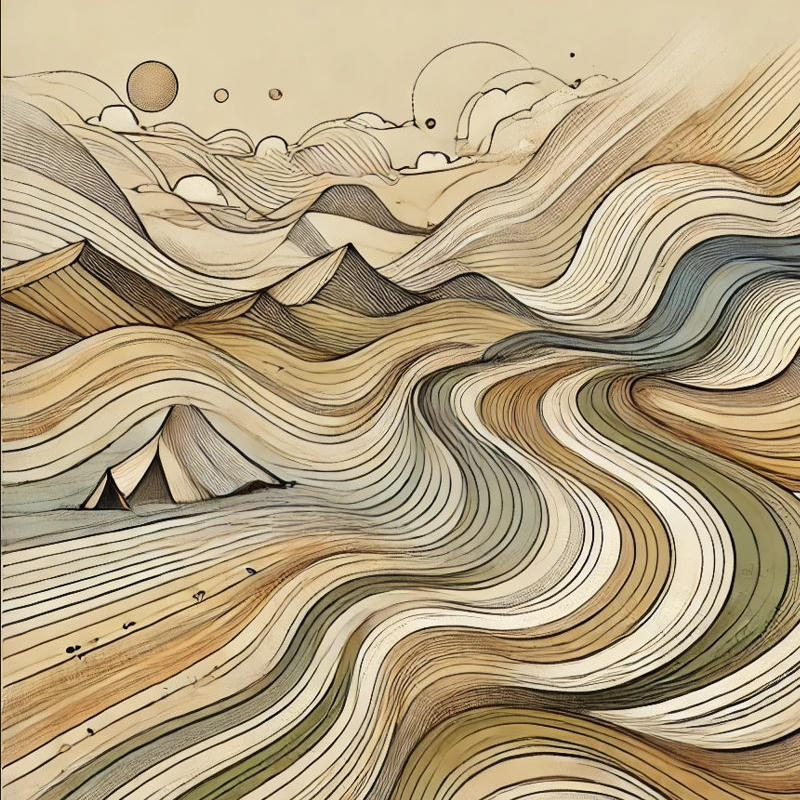
The ever-increasing pace of everyday life, the frequently changing socio-political, economic conditions and the contemporary 'stress' of the city have led to the redefinition of the habitation space, significantly freeing it from the notion of the permanent and the fixed. In this way, the concept of the nomad returns to the fore, carrying a different connotation from that of the past. In the context of this research paper, we will deal with how the concept of nomadism manifests itself and influences architecture up to the present day.
The first section will contain a description and historical background of the concept of nomadism and the reasons that led to it. There will also be a special emphasis on ephemeral construction and its materiality. Then, from Gilles Deleuze's and Felix Guattari's view of nomadic and static space, the characteristics of both, the way they are inhabited, will be identified and the methodology for analysing selected, contemporary and past, architectural examples will also emerge.
The second section explores the concept of movement and immobility as well as their relationship with space and the influence they have on the final configuration of a building's architecture. It also emphasises the different experience that this space offers to the visitor.
The third section explores the concept of movement and the various types of nomadic practices that were first developed in the 1960s. Where for the first time urban planning proposals with a nomadic character far from the strict rules of modernism were realised.
Finally, focusing on examples of contemporary architecture, we note how they respond to the socio-political and economic factors that have developed in our times. From their analysis we observe how the nomadic experience is reflected in the static architectural spaces of today.