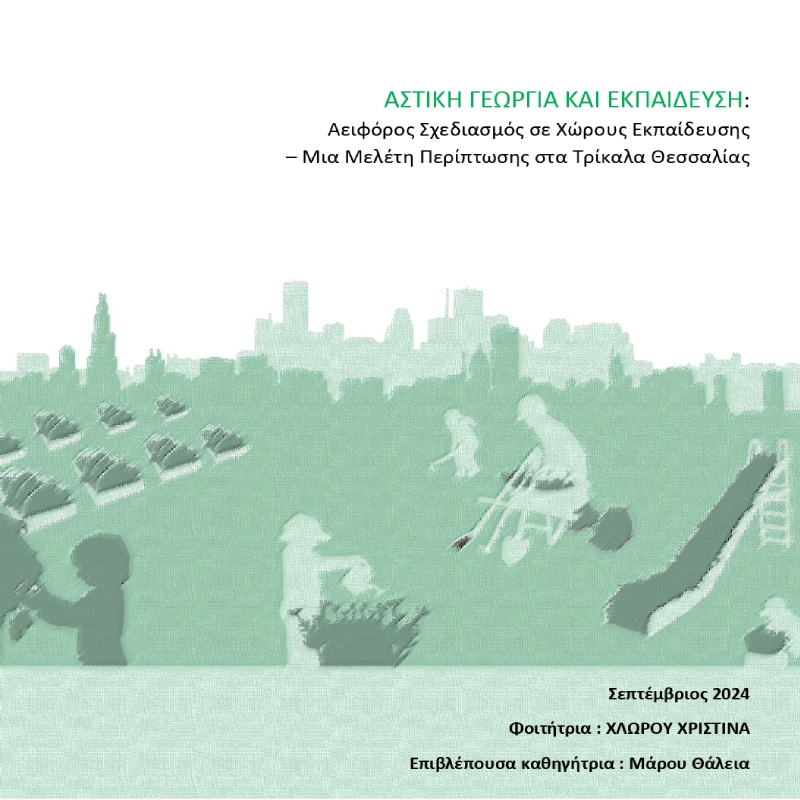
This project explores the role of urban agriculture in the design of cities through various dimensions (e.g., social, environmental), as well as its relationship with education, through new methods and approaches, such as school gardens. In the first part, a brief reference is made to the definition of urban agriculture, its categories, the benefits as well as the obstacles that make its implementation difficult. Then, the historical development of the relationship between nature and urban fabric, through urban cultivation and landscape architecture, in Europe and the first attempts to integrate it in Greece is developed.
In the second part of the project, the relationship between urban agriculture and education and school spaces is studied. These spaces can form the basis for activating students' awareness of the natural environment and the implementation of projects that contribute to the promotion of sustainable development. Also, applied examples of sustainable school gardens abroad are listed as well as the first attempts to implement them in Greece.
In the last part of the project, utilizing the information and knowledge collected from all of the above, a case study is carried out at the Kindergarten "The Child's Dream", in the city of Trikala, Thessaly, a school that was created and designed with a vision of Environmental Education. The purpose of the research is to record the goals of the specific school and its physical organizational and functional characteristics. Research question of the case study is to verify or not, whether the forecourt can be used as an educational space and which of their facilities contribute to this as well, and what is its contribution to the sustainability of the urban environment of the study area.