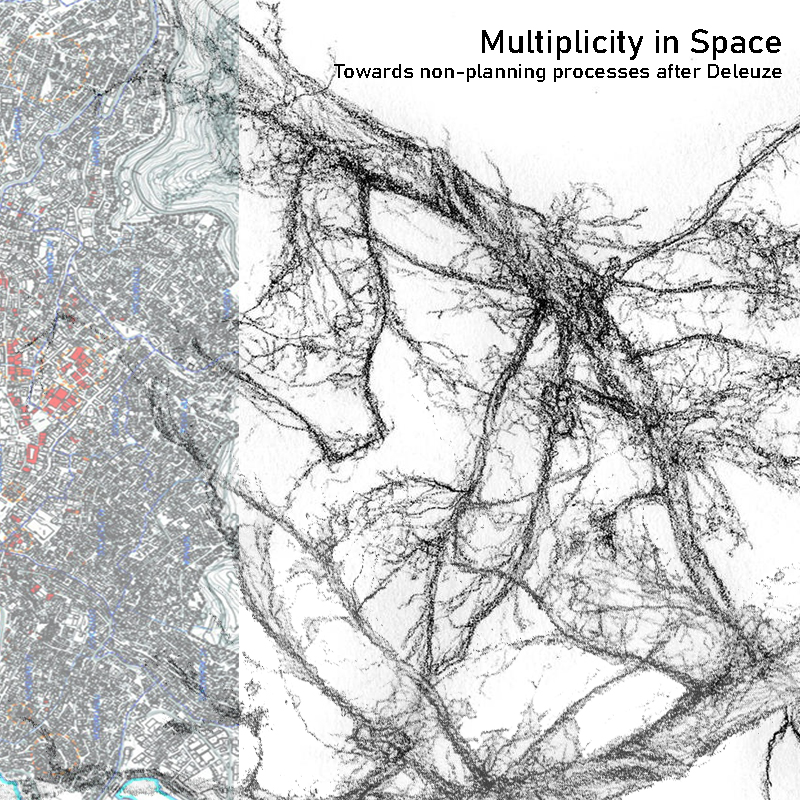
Space and philosophical thought are two entities that interact and exchange knowledge, interpretations, and experiences, acting as feedback tools for each other. Poststructuralism and its exponents developed different approaches to spatial planning both conceptually and pragmatically. From what is space and what is its ontological status to its control tools (planning and policy), the last decades - or rather the last century now - have made a decisive contribution to the philosophical thinking around the issues of space. Two of these exponents are Gilles Deleuze and Felix Guattari, whose contribution intervenes and directly affects the field, urban theories and practice especially in contemporary times. Despite the fact that the international bibliography is not rich in the combination of specific philosophical thought and spatial sciences, the present monograph is perhaps an attempt on the one hand at a coupling of these and on the other hand at a more personal exploratory approach all around the fields of spatial planning.
Based on the aforementioned, this research work is run by two intersecting axes, the Deleuzoguattarian multiplicity and the conceptual and pragmatic framework of space. In this way, the multiplicity is transferred to the space not necessarily as an allegorical connection but mainly as a means of reconceptualizing the space that can potentially bring about a different spatial planning. A spatial planning that will respect and defend the uncertainty of its nature and will make changes only following circumstances, in other words, a situational planning. Because of the chosen subject area, the word conclusion is missing from this monograph. Because just as there is no beginning, so there is no end. There is only the middle, the intermezzo, and the sense of process. Therefore, let this monograph be a discussion process that may lead nowhere.