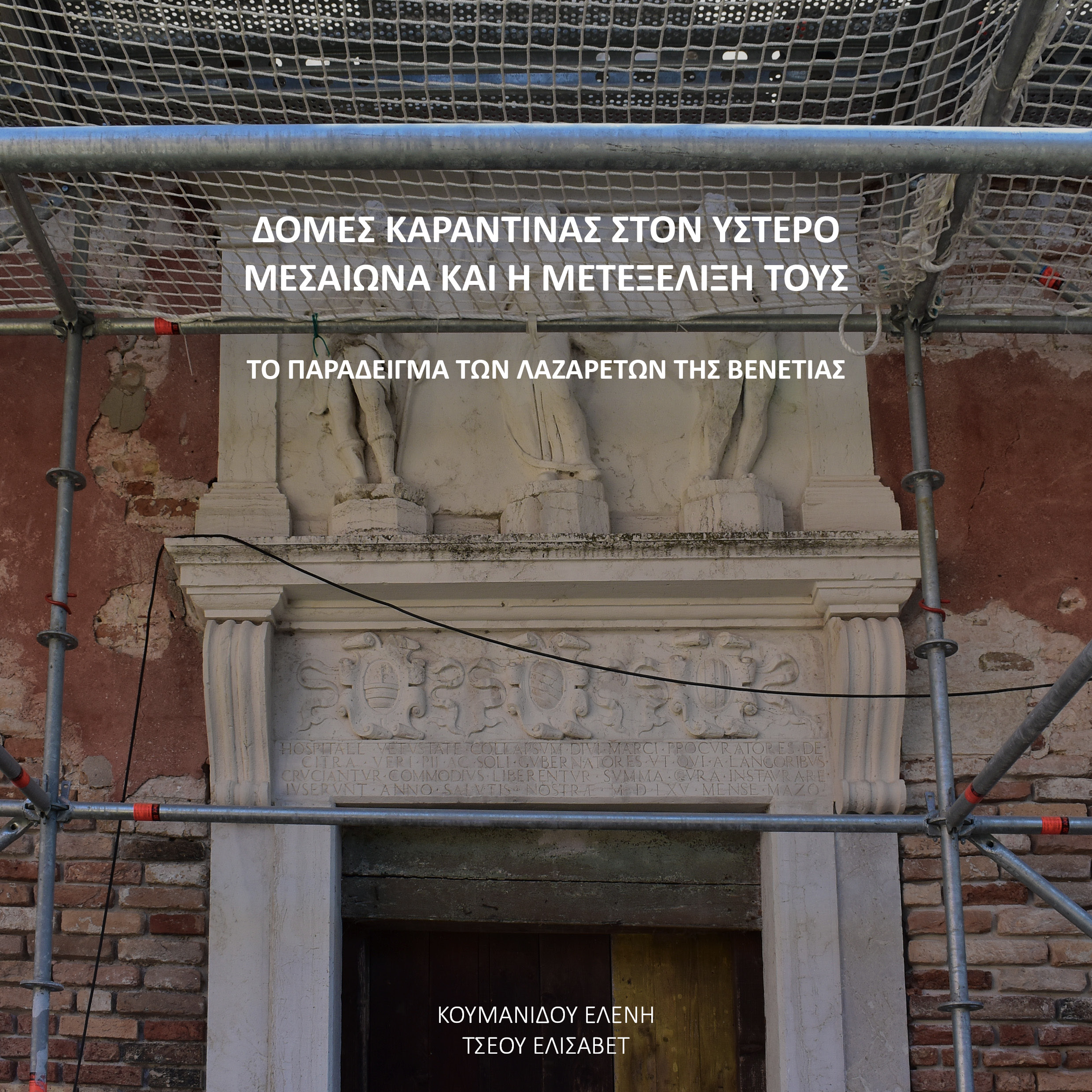
The present research project entitled "Structures of Quarantine in the Late Middle Ages and their Evolution - The Example of the Lazarets of Venice" was prepared by the students Koumanidou E. and Tseou E. under the supervision of professor Fatsea E. In the following paper, prompted by the Covid-Sars-19 virus pandemic, an attempt is made to analyse the relationship between architecture and the practice of quarantine through the first structures that emerged to deal with the plague in Europe, and more specifically in the Mediterranean, in the late Middle Ages. Starting from the Venetian Lazarets, a structural and functional analysis is made of them using bibliographical sources as well as an on-site autopsy. The analysis of these two Lazaretes includes their history before they were established as quarantine sites, their spatial relationship with Venice, the architectural analysis of their building complexes and their subsequent development after the end of the epidemics. Following this, the research investigates similar structures, both built and theoretical, in the wider Mediterranean area. The influence on the Venetian Lazarets is explored through various perspectives, seeking similarities and common features. Finally, conclusions and comments on all the above are presented in four sections. The first section looks at the relationships between quarantine, incarceration and state control. The second section attempts to compare quarantine in the late medieval period with the present day. The third section is a broader look at the course of evolution of all the quarantine structures analysed in this paper, while the fourth and final section examines the prominent importance of unimpeded trade in relation to quarantine structures.