

GREESIS
Identity as Action
Lecture Series, Department of Architecture University of Thessaly, 2011
Editors: Phoebe Giannisi, Iris Lykourioti, Yorgos Tzirtzilakis
The effects of the economic crisis in Greece introduced a rupture in the stability of everyday life, bringing us under a state of emergency.
Highlighting and examining this new condition, we invite a series of actions undertaken by political scientists, writers, architects and artists under the title GREESIS. (GREECE+CRISIS=GREECE IS).
Praxis(action) is the root of the word πραγματικότητα(pragmatikotita) in greek, meaning reality. Reality is being formed constantly through the actions of people. Identity in this light is a political entity and corresponds to the way someone acts within the sphere of community.
Taking as a point of reference Hannah Arendt’s book Vita Activa, we are interested to address issues regarding geopolitics, biopolitics, the role of agricultural production, philhellenism, the greek cultural dilhemma between the east and the west and immigration, in order to understand better the connection between Greece and the global economic crisis through its impact in space and social structure.
ALTERNATIVE TEMPORARY DWELLING
TEACHING
Elias Zenghelis, Professor, Berlage Institute
Teaching assistants: Fyllio Katsavounidou, Nikos Platsas, Savina Derdelakou, Ioannis Baltogiannis
WHEN / WHERE
Friday 26 August through Sunday 4 September 2011
St. Nicholas – Paou Monastery, Argalasti, Pelion, Greece
THEME
Participants will examine alternative ways of temporary dwelling as well as its relation to the landscape; these could include educational installations which leave no permanent traces.
The concept of integration in the landscape is projected neither with modest humility nor as an abandonment of architecture’s jurisdiction but rather as an emphatic juxtaposition of the intrinsic properties and of the oppositions between the two. That is, of the dialectic that underpins and juxtaposes the constitution, on one hand, of the evolutionary dynamics of nature and, on the other, of the static balance of the human artifact.
WHO
The workshop is open to undergraduate students in the last years of their studies, to graduate students and to young architects (who have graduated in the last five years). Participants, 18 in total, will be selected on CV / portfolio basis.
STAY & COST
Τhe workshop will take place in the Monastery of Paou in Pelion, Greece (www.monipaou.gr), where participants will also be housed. Included in the participation price (300 euros) are: tuition fees, stay, as well as a daily excursion in the area.
HOW TO APPLY
Please send your application (include a 2-page pdf with 150-words cv and sample of portfolio) to pelion.aw@gmail.com (deadline: 31 July, 2011).
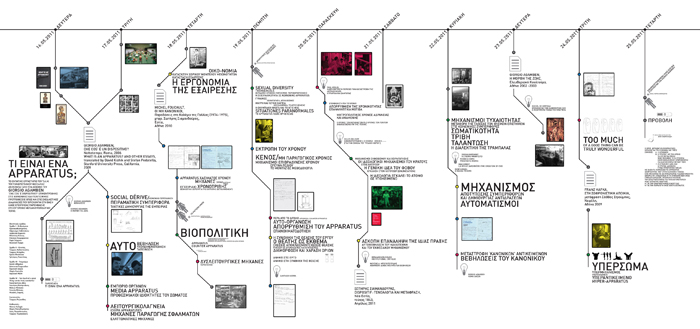
Giorgio Agamben, “Che Cos’ è un Dispositivo?”, Nottetempo, Roma, 2006
Giorgio Agamben, “What is an Apparatus?”, translated by David Kishik and Stefan Pedatella, Stanford University Press, California, 2009
The 2011 workshop Erasmus IP "Changing Landscapes - Mediterranean Sensitive Areas Design" took place in the University of Thessaly in Volos, from Thursday 2nd to Thursday 16th of June, 2011.
Description
The Changing Landscape/ Mediterranean Sensitive Areas Design Project it is a joint program which brings together European Schools of Architecture and Landscape design allowing to face and to share different attitudes, strategies, politics of intervention focussing on Mediterranean critical areas, where the landscape project (in terms of value and quality) imbeds a cultural dimension and serves as sources of reference.
The project objective is to strengthen the research focussing on the values and sensitiveness applied to the landscape project, in both meaning the aesthetic-cultural and the ecological-environmental. It will be helpful to lead new strategies of intervention for this particular situation. Themes are different: abandoned industrial areas, suburban areas, the public space system for the city, parks and gardens design into marginal ambits, coastal line and infrastructures, all things that need a definition of problems and most of all correct approaches to work out in the “landscape system”. So to build, with this experience, a disciplinary specialization and to enlarge the educational system, and over to share and to favour cultural exchanges between all involved Universities.
Participating universities:
UNIRC - Università mediterranea di Reggio Calabria / Mediterranea Univesity of Reggio Calabria
TUM - Technische Universität München / Technical University of Munich – GERMANY
UPC Universitat Politécnica de Catalunya/Technical University of Catalonia - SPAIN
ETSAB - Escola Tècnica Superior d’Arquitectura de Barcelona
UMA Universidad de Málaga/University of Málaga - SPAIN
Universidade Lusiada de Lisboa/Lisboa Lusiada University – PORTUGAL
UTH - University of Thessaly - GREECE
IUAV - Università IUAV di Venezia/ University IUAV of Venice - ITALY
Politecnico di Milano – ITALY
More information: http://www.changinglandscapes.eu/
Greesis #1
Dimitris Antonakakis
The House of the Sorceress: Wandering about the ‘60s
Wednesday, May 3rd, 2011
Time: 8.00
Post Graduate Loft Space, Department of Architecture, Pedion Areos, Volos
CV
Dimitris Antonakakis was born in Chania, Crete in 1933. He graduated from the School of Architecture of NTUA in 1958, where he continued teaching until 1992. Since 1958 he has been working together with Susana Antonakaki with whom he co-founded Atelier 66. He has been a prominent member of the Association of Greek Architects and of the teaching staff of the International Design Seminar at the School of Architecture of TU Delft and in 1988 in Split, invited by Herman Herzberger. Since 1995 he is a member of Academie d' Architecture in France and since 1998 an honorary member of the Association of Architects in Crete. He has been teaching as visiting professor in MIT, in NTUA, in the Department of Architecture of the University of Patras. He is the director of the Center of Mediterranean Architecture in Chania, Crete.
Second semester field trip to Switzerland in spring 2011.
The Department of Architecture, Aristotle University of Thessaloniki, organises an exhibition and a symposium titled: "Building: Design, Construct, Think"
17 February - 3 March 2011
http://www.katoikia2.blogspot.com/
Presentation "Απο-οικειοποίηση: Γλώσσα και Πράξη" E.Gavrilou, P.Giannisi & K.Paniyiris [in greek]