
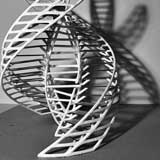
This exhibition presents the outcomes of the course Special Topics in Digital Fabrication, Processes and Technologies offered in the 9th semester of the Department of Architecture at the University of Thessaly. The exhibited work consists of nine group projects, each focused on the design and fabrication of a staircase at a 1:10 scale.
A central pedagogical and technical aim of the course was the exclusive use of digitally controlled fabrication machines for the development of the projects. The implementations employed 3D printing, laser cutting, and a robotic arm, in order to investigate the reciprocal relationship between form generation, fabrication logics, and machine constraints.
In addition to the physical outcomes, the exhibition includes video documentation of the fabrication processes. The presentation of this “backstage” material is considered an integral part of both the educational and design methodology. By foregrounding the sequential steps of production—ranging from the preparation of CAD/CAM files and the generation of G‑code to tool calibration and machine operation—the exhibition seeks to introduce a critical shift from architecture’s prevailing emphasis on the “image” toward a deeper understanding of the methods, decisions, and constraints that shape the final artefact. In this context, the disclosure of processes operates as a counterpoint to modes of presentation that frequently conceal essential issues of design and fabrication, redirecting attention from aesthetic impression to methodical, verifiable, and shareable knowledge.
Theoretical Framework — Anti‑Manifesto
Access to Tools = Access to Knowledge
-
The non-neutrality of technology.
Fabrication machines co‑shape relations of power, knowledge, and access. Architecture must recognize the implications of these relations and reconfigure them toward social inclusion and equity. -
Design as an emancipatory act.
Direct engagement with fabrication tools—from G‑code and CAM to the milling bit and the printer nozzle—reveals how knowledge emerges through process and enables its transformation into a shared resource. -
Openness as a prerequisite for dissemination.
The availability of files, standards, and workflows (open files, open standards, open workflows) reduces barriers to access, strengthens learning communities, and expands the potential for creative inquiry. -
A bidirectional articulation of design and fabrication.
Digital fabrication machines do not merely execute predefined designs; they co‑constitute them by imposing constraints and offering new possibilities. Design must incorporate the logics of fabrication and convert them into creative agency. -
The staircase as object and symbol.
The staircase is approached as a structural, social, and symbolic element: it connects levels, communities, and bodies of knowledge. Its fabrication—even at a reduced scale—constitutes an act of social engineering, rendering the notion of access tangible, material, and open to negotiation.